NIST finalizes post-quantum cryptography standards
On June 22, 2026, President Trump signed Executive Order 14412, "Securing the Nation Against Advanced Cryptographic Attacks," marking the transition of post-quantum cryptography from academic proposal to enforceable regulation. This directive mandates the immediate migration of federal systems to quantum-resistant algorithms, setting a binding precedent for private sector financial infrastructure.
NIST’s finalization of these standards concludes a rigorous multi-year evaluation process. As outlined in the January 2026 NIST Post-Quantum Cryptography Project presentations, the selected algorithms were chosen for their resistance to both classical and quantum computing attacks. The standards now serve as the technical baseline for compliance, requiring organizations to replace vulnerable RSA and elliptic-curve cryptography with lattice-based and hash-based alternatives.
The signing of Executive Order 14412 transforms post-quantum cryptography from a future consideration into an immediate compliance requirement for federal and private sector crypto infrastructure.
This regulatory shift creates an urgent timeline for asset protection. Financial institutions and technology providers must now audit their cryptographic inventory against the new NIST benchmarks. The window for voluntary migration is closing, replaced by a compliance framework that treats quantum readiness as a fundamental security obligation rather than an optional upgrade.
Why quantum threats change crypto wallet security
The threat to your crypto wallet isn't theoretical anymore. It is a mathematical certainty waiting for hardware to catch up. Current blockchain signatures rely on elliptic curve cryptography (ECDSA or EdDSA) to prove you own your assets. These algorithms are secure against classical computers, but they are brittle against quantum machines.
A sufficiently powerful quantum computer running Shor's algorithm can reverse the one-way functions that protect these signatures. In practical terms, this means an attacker could derive your private key from your public key. Once they have that key, they can sign transactions as you, draining your wallet with zero friction. The vulnerability exists because the public key is visible on the blockchain before any transaction is signed.
This "harvest now, decrypt later" strategy is already active. Adversaries are collecting blockchain transactions today, storing the encrypted data, and waiting for quantum capability to unlock it. By 2026, the window to migrate has narrowed significantly. We are no longer debating the technology; we are racing against the clock.
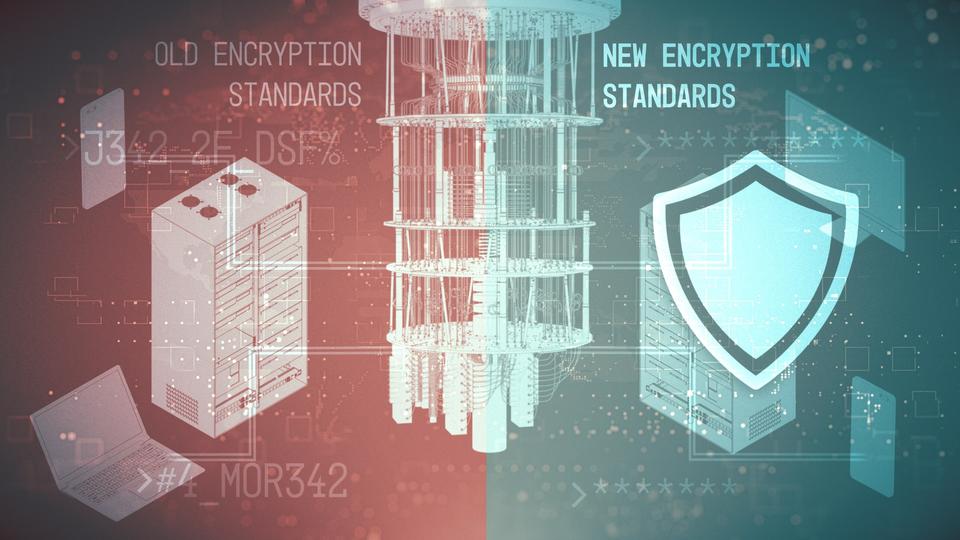
NIST's finalization of post-quantum algorithms in 2024 and 2025 marks the end of the research phase and the start of the implementation phase. The standards provide the blueprint, but wallet providers and blockchain networks must now update their infrastructure. The urgency is driven by the fact that migration is complex and time-consuming. Delaying the switch leaves assets exposed to a threat that is growing stronger every day.
NIST quantum-resistant encryption algorithms for blockchain
Legacy elliptic curve cryptography (ECC) is reaching its expiration date. As quantum computing capabilities advance, the mathematical foundations of ECDSA and EdDSA—currently securing most blockchain networks and digital wallets—become vulnerable to Shor’s algorithm. NIST has finalized the first set of post-quantum standards to replace these legacy systems. For blockchain infrastructure, this transition means swapping signature schemes and key encapsulation mechanisms with algorithms designed to withstand quantum attacks.
The primary signature standard replacing ECDSA is ML-DSA (Module-Lattice-Based Digital Signature Algorithm), standardized as FIPS 204. ML-DSA offers a balance of security and performance, with variants tailored for different use cases. ML-DSA-44 provides a security level comparable to 128-bit symmetric encryption, suitable for general transactions. ML-DSA-65 and ML-DSA-87 offer higher security margins (192-bit and 256-bit equivalent) for high-value assets or long-term storage, though they come with larger signature sizes. This size increase is a trade-off for quantum resistance; while signatures are larger than ECDSA’s 64 bytes, they remain manageable for blockchain blockspaces.
For key exchange and encryption, NIST standardized ML-KEM (Module-Lattice-Based Key Encapsulation Mechanism) as FIPS 203, replacing traditional Diffie-Hellman exchanges. ML-KEM-512, ML-KEM-768, and ML-KEM-1024 correspond to the same security levels as ML-DSA-44, -65, and -87. ML-KEM-768 is often recommended as the default for new implementations, offering 192-bit security with a public key size of 1,184 bytes and a ciphertext size of 1,088 bytes. This is significantly larger than ECDH’s ~32-64 bytes, but it ensures that encrypted session keys remain secure against future quantum decryption attempts.
The shift from legacy ECC to NIST’s lattice-based standards is not just a technical upgrade; it is a fundamental change in how blockchain networks prove ownership and secure communications. Wallet providers, exchanges, and layer-1 protocols must integrate these algorithms into their transaction validation logic and network protocols. The table below compares the key characteristics of the legacy standards against their NIST replacements.
| Standard | Type | Legacy Equivalent | Security Level (Symmetric Eq.) | Key/Signature Size |
|---|---|---|---|---|
| ML-DSA-44 | Signature | ECDSA (P-256) | 128-bit | Larger (1.3-2.5 KB) |
| ML-DSA-65 | Signature | EdDSA (Ed25519) | 192-bit | Larger (1.9-3.5 KB) |
| ML-DSA-87 | Signature | ECDSA (P-384) | 256-bit | Larger (2.5-4.8 KB) |
| ML-KEM-768 | Key Encapsulation | ECDH (P-256) | 192-bit | Larger (1.1 KB public key) |
PQC migration for blockchain infrastructure
Use this section to make the Post-Quantum Cryptography decision easier to compare in real life, not just on paper. Start with the reader's actual constraint, then separate must-have requirements from details that are merely nice to have. A practical choice should survive normal use, maintenance, timing, and budget. If a recommendation only works in an ideal situation, call that out plainly and give the reader a fallback path.
-
Verify the basicsConfirm the core specs, condition, and fit before comparing extras.
-
Price the downsideLook for the repair, maintenance, or replacement cost that would change the decision.
-
Compare alternativesCheck at least two comparable options before treating one listing as the benchmark.
Market Impact and Crypto Asset Valuation
The finalization of NIST post-quantum cryptography standards marks a structural shift in how digital assets are valued and secured. For institutional investors, the transition is not merely a technical upgrade but a compliance imperative that influences capital allocation. Assets that fail to demonstrate quantum-resilient security frameworks face increasing scrutiny, potentially leading to a "security discount" in valuation models.
Institutional adoption of these standards creates a premium for assets that prioritize long-term cryptographic integrity. As major financial entities migrate their infrastructure, the market distinguishes between legacy systems and quantum-ready platforms. This divergence is likely to widen the spread in risk-adjusted returns, with compliant assets commanding higher trust and lower insurance premiums.
Market volatility often spikes during major security announcements, reflecting the market's sensitivity to infrastructure risks. The following chart illustrates Bitcoin's price action, providing context for how significant security milestones can influence broader market sentiment and liquidity.
No comments yet. Be the first to share your thoughts!