The 2026 regulatory pressure on crypto privacy
The landscape for digital privacy is shifting from voluntary adoption to regulatory mandate. By 2026, the European Union’s eIDAS regulation has moved from proposal to enforcement, creating a legal framework that demands verifiable compliance without exposing underlying user data. This shift forces institutions to abandon "privacy by obscurity" in favor of cryptographic proof.
For traditional finance, this is the missing link. Historically, regulators required full transaction visibility to combat money laundering, while institutions needed to protect client confidentiality. Zero-knowledge proofs resolve this tension by allowing a system to prove that a transaction meets all legal criteria—such as age verification or anti-money laundering checks—without revealing the actual details of the user or the trade.
This pressure is not limited to Europe. Major networks are already integrating native support for these proofs to meet institutional demand. For example, the XRP Ledger recently integrated with Boundless, a zero-knowledge proving network, to enable privacy-preserving compliance checks. This move signals that the industry is no longer waiting for regulations to catch up; it is building the infrastructure to meet them.
The result is a new standard where privacy is not a feature to be toggled off, but a cryptographic guarantee enforced by the protocol itself. Institutions can now satisfy auditors and regulators while keeping sensitive financial data strictly confidential.
Tracking ZK-Rollup Adoption Metrics
The shift from experimental zero-knowledge proofs to institutional infrastructure is measurable through on-chain volume and network integration. ZK-rollups are no longer just a theoretical solution for scalability; they are becoming the standard for private, compliant financial settlement.
Market data reveals a steady increase in daily transaction throughput for leading ZK-rollup networks. This growth correlates with the deployment of privacy-preserving smart contracts and institutional-grade identity verification layers. The trend indicates that ZK-technology is moving beyond speculative DeFi into core financial infrastructure.
Tracking these metrics provides a clear view of market sentiment. As regulatory frameworks like the EU's eIDAS 2.0 take effect in 2026, the demand for verifiable privacy without transparency will drive further adoption. The data suggests that ZK-rollups are positioning themselves as the backbone of the next generation of secure digital finance.
Key ZKP applications for institutional finance
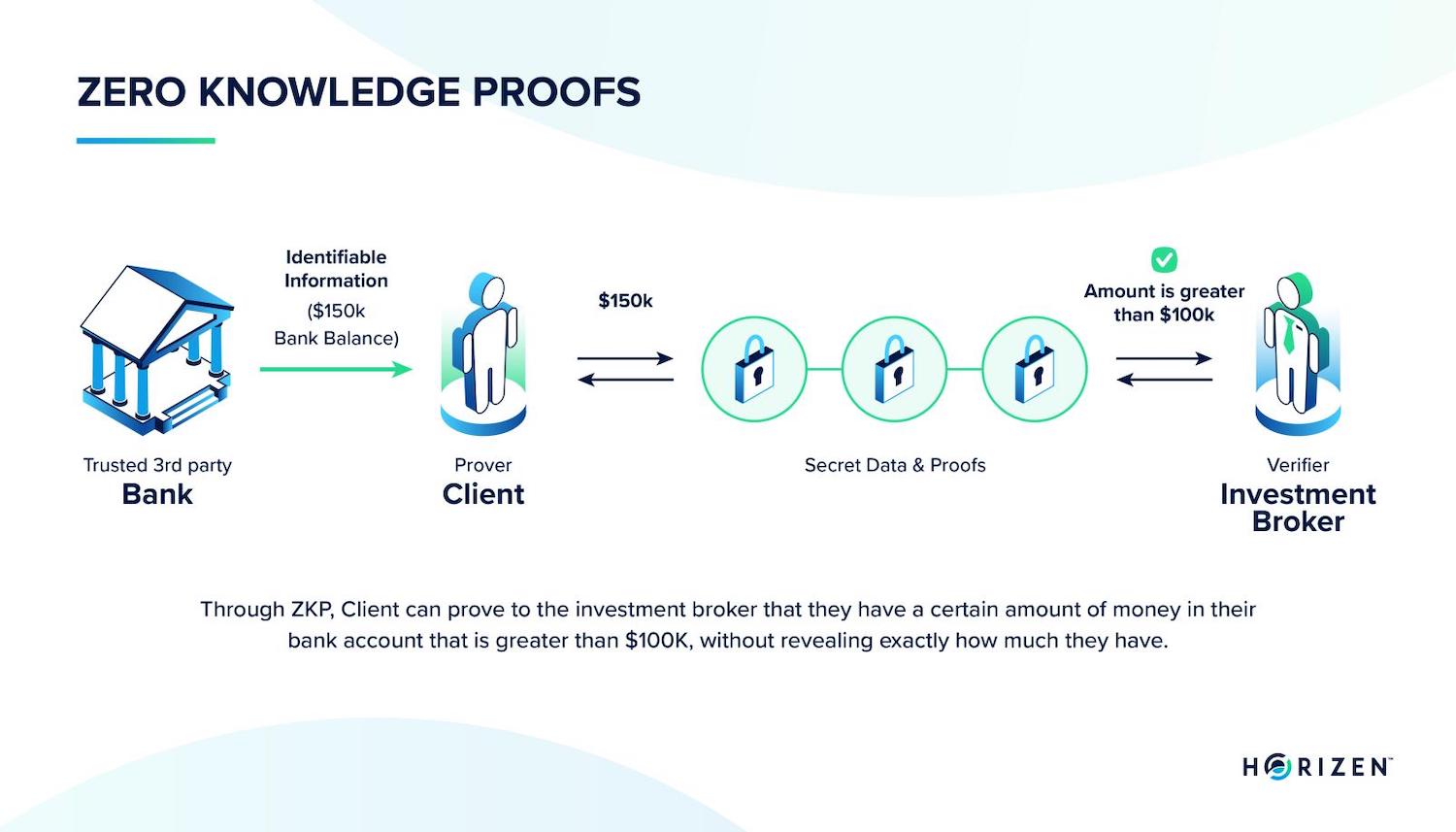
Zero-knowledge proofs are moving from experimental cryptography to the core infrastructure of institutional finance. In 2026, the primary use cases are proof-of-reserves, private transactions, and identity verification. These applications allow institutions to prove compliance and solvency without exposing sensitive client data or trading strategies.
Proof of reserves
Regulators and clients demand transparency, but banks cannot publish their entire ledger. ZKPs solve this by allowing an institution to generate a cryptographic proof that its assets exceed its liabilities. This verification happens without revealing the specific accounts or transaction history involved. Early research into proof-of-reserve schemes on Bitcoin demonstrates how users can prove ownership of UTXOs exceeding a threshold without disclosing transaction details [[src-serp-5]]. This approach builds trust while maintaining strict operational secrecy.
Private transactions
Institutional traders often need to execute large orders without signaling intent to the market. Traditional privacy coins face regulatory scrutiny, but ZKP-enabled transactions offer a compliant middle ground. Institutions can prove that a transaction is valid and funded without revealing the sender, receiver, or amount. The XRP Ledger recently added native support for ZKP verification, targeting the institutional privacy gap that traditional blockchains cannot fill [[src-serp-5]]. This integration allows for confidential transfers that still satisfy audit requirements.
Identity verification
Know Your Customer (KYC) processes are notoriously slow and data-heavy. ZKPs enable selective disclosure, where a user proves they meet a criterion, such as being over 18 or residing in a specific jurisdiction, without sharing their birthdate or address. This reduces data breach risks and speeds up onboarding.
| Feature | Traditional KYC | ZKP-Based KYC |
|---|---|---|
| Data Exposure | Full personal data shared | Minimal proof only |
| Verification Speed | Days to weeks | Seconds to minutes |
| Privacy Risk | High (centralized storage) | Low (no raw data stored) |
These three applications form the foundation of the institutional privacy standard. By proving facts without revealing secrets, ZKPs align the needs of compliance with the imperative of security.
Bitcoin and XRP integration challenges
Applying zero-knowledge proofs (ZKPs) to legacy chains like Bitcoin and XRP requires overcoming significant technical and regulatory hurdles. While these networks offer unparalleled liquidity and security, their foundational designs were not built for the complex cryptographic verification that ZKPs demand.
Bitcoin’s utxo limits to account for
Bitcoin’s unspent transaction output (UTXO) model creates unique friction for ZK implementation. Unlike account-based ledgers, Bitcoin does not store user balances in a single state. Proving ownership or compliance without revealing transaction details requires intricate proof-of-reserve schemes.
Recent research demonstrates how ZKPs can verify UTXO ownership thresholds without exposing the underlying transaction data [1]. However, the computational cost of generating these proofs remains high. For institutional adoption, the system must scale to handle millions of daily transactions without bogging down the network.
XRP’s Native ZK Integration
The XRP Ledger (XRPL) has taken a more direct approach by integrating native support for ZK proof verification. In April 2026, the XRPL partnered with Boundless, a ZK proving network, to enable on-chain verification [2]. This marks the first deployment of its kind on the ledger, targeting the institutional privacy gap.
This integration allows developers to build privacy-preserving applications directly on the XRPL. It reduces the reliance on external layers, potentially lowering latency and costs. However, the regulatory clarity surrounding these on-chain proofs remains an open question for global institutions.
Market Context
The push for privacy on legacy chains is driven by institutional demand. As regulations tighten, firms need tools to prove compliance without exposing sensitive trade data. The following chart shows the current market sentiment for Bitcoin, reflecting the broader interest in privacy-enhancing technologies.
Community Sentiment
The feasibility of ZKPs on these networks is a hot topic among developers and investors. Recent discussions highlight the balance between privacy and regulatory compliance.
The Path Forward
For ZKPs to become the institutional privacy standard, legacy chains must evolve. Bitcoin needs more efficient proof generation, while XRP must prove its regulatory resilience. The technology is ready; the infrastructure is catching up.
Choosing a ZK-proof provider in 2026
Selecting a ZK-proof provider is no longer just a technical decision; it is a risk management exercise. Institutions must prioritize solutions that have survived rigorous third-party audits and align with emerging industry standards. The margin for error is thin, and the cost of a flawed implementation is total reputational and financial loss.
Audit Rigor and Standard Compliance
A provider’s security posture is defined by its audit history. Look for solutions that have undergone multiple independent reviews by reputable firms, not just self-certified claims. Equally important is adherence to the ZKProof standards. This open-industry academic initiative works to mainstream ZKP cryptography through community-driven validation, providing a baseline for trustworthiness that institutions can rely on. ZKProof remains the primary reference for these compliance benchmarks.
Scalability and Cost Efficiency
Proof generation time and verification cost determine whether a solution is viable for high-frequency institutional use cases. Providers differ significantly in their circuit efficiency and prover speed. Evaluate their ability to handle batched transactions and large datasets without prohibitive latency. The goal is to find a balance where privacy does not come at the expense of operational speed or exorbitant computational costs.
Market Context and Adoption
The financial landscape for ZK technology is evolving rapidly, with major networks integrating native verification. For instance, the XRP Ledger recently added native support for ZK proof verification through Boundless, marking a significant step toward institutional privacy. Tracking these adoption trends alongside live market data helps identify which providers are gaining real-world traction.
No comments yet. Be the first to share your thoughts!