What changed in zero-knowledge proofs 2026
The landscape for zero-knowledge proofs 2026 has shifted from experimental cryptography to regulated infrastructure. This transition is driven by two converging forces: the enforcement of the EU’s eIDAS 2.0 regulation and the maturation of ZKProof standards. For legal and compliance teams, this means ZKPs are no longer just a privacy feature for blockchain enthusiasts; they are becoming a mandatory tool for age assurance and identity verification.
The European Union’s eIDAS 2.0 regulation, set to take full effect in 2026, creates a legal framework that favors privacy-preserving technologies. Unlike previous iterations, the new regulation explicitly supports the use of zero-knowledge proofs for age assurance, allowing users to prove they are over a certain age without revealing their birth date or identity. This regulatory push has accelerated enterprise adoption, as organizations seek compliant ways to verify credentials without storing sensitive personal data.
Simultaneously, the ZKProof initiative has moved from theoretical papers to practical, audited standards. As an open-industry academic initiative, ZKProof has established a rigorous framework for verifying the correctness of zero-knowledge protocols. This standardization reduces the risk of implementation errors and provides a clear benchmark for enterprises looking to deploy ZKPs in high-stakes environments. The combination of regulatory mandate and technical standardization marks a pivotal moment for the technology.
| Aspect | Pre-2026 | 2026 Standard |
|---|---|---|
| Regulatory Status | Unregulated niche | eIDAS 2.0 compliant |
| Technical Trust | Community audited | ZKProof standardized |
| Primary Use | Crypto privacy | Enterprise identity |
zk-SNARKs vs zk-STARKs: Core differences
In 2026, regulatory frameworks for zero-knowledge proofs 2026 demand transparency regarding the underlying cryptographic assumptions. Organizations must select proof systems that balance privacy with verifiable security guarantees. The choice between zk-SNARKs and zk-STARKs hinges on three critical factors: trust assumptions, proof size, and verification speed.
zk-SNARKs (Succinct Non-Interactive Arguments of Knowledge) offer compact proof sizes and fast verification, making them ideal for blockchain scalability. However, they require a trusted setup phase. This initial ceremony generates public parameters that, if compromised, could allow an attacker to forge proofs. This dependency introduces a specific compliance risk that legal teams must evaluate.
zk-STARKs (Scalable Transparent Arguments of Knowledge) eliminate the trusted setup requirement by relying on publicly verifiable randomness. This transparency aligns better with strict regulatory standards that prohibit reliance on secret ceremonies. While STARKs produce larger proofs and require more computational power to generate, their quantum-resistant security properties and transparency make them increasingly attractive for high-stakes financial applications.
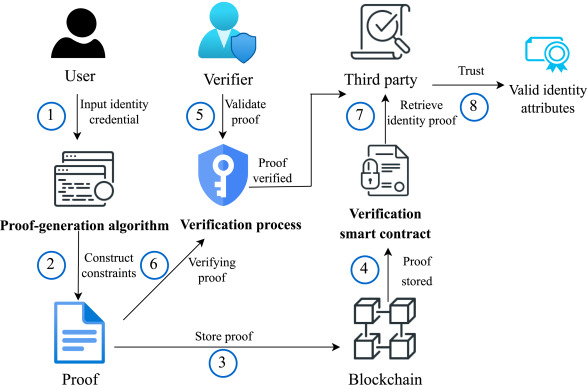
The following table summarizes the technical distinctions between these two dominant proof types.
| Feature | zk-SNARKs | zk-STARKs |
|---|---|---|
| Trust Assumptions | Requires trusted setup | Transparent (no trusted setup) |
| Proof Size | Small (~KB) | Large (~MB) |
| Verification Speed | Fast | Slower |
| Quantum Resistance | No | Yes |
| Primary Use Case | Mobile wallets, L2s | High-security finance, enterprise |
For organizations prioritizing immediate scalability and user experience on mobile devices, zk-SNARKs remain the standard. However, as regulatory scrutiny intensifies around cryptographic trust models, zk-STARKs offer a more defensible posture for enterprise-grade compliance. The decision ultimately depends on whether minimizing data transmission or maximizing cryptographic transparency is the higher priority for your specific use case.
Homomorphic encryption vs zero-knowledge proofs
Homomorphic encryption (HE) and zero-knowledge proofs (ZKP) both address data privacy, but they serve fundamentally different regulatory and technical needs. Understanding the distinction is essential for compliance officers selecting tools for 2026. HE allows computation on encrypted data, while ZKPs verify the validity of data without exposing it.
Computing on Encrypted Data
Homomorphic encryption enables third parties to perform calculations on ciphertexts. The result, when decrypted, matches the result of operations performed on the plaintext. This is critical for scenarios where data must remain encrypted during processing, such as in cloud-based healthcare records or financial auditing.
However, HE is computationally expensive. The latency and resource requirements often make it impractical for real-time applications. It is best suited for batch processing or scenarios where the data owner retains control over the decryption key after computation.
Proving Knowledge Without Revealing It
Zero-knowledge proofs 2026 standards emphasize verification over computation. A ZKP allows a prover to demonstrate that a statement is true without revealing any information beyond the truth of that statement. For example, a user can prove they are over 18 without disclosing their birth date.
This approach is lighter on computational resources than HE for verification tasks. It is ideal for identity verification, transaction validation, and regulatory compliance checks where the goal is to prove adherence to rules without exposing underlying sensitive data.
Choosing the Right Tool
The choice between HE and ZKP depends on the specific compliance requirement. If the goal is to enable secure computation on sensitive data by a third party, HE is the appropriate tool. If the goal is to verify compliance or identity without exposing the underlying data, ZKP is more efficient and scalable.
| Feature | Homomorphic Encryption (HE) | Zero-Knowledge Proofs (ZKP) |
|---|---|---|
| Primary Function | Computation on encrypted data | Verification of statements |
| Data Exposure | Data remains encrypted during compute | No data revealed during verification |
| Computational Cost | High | Moderate to Low |
| Best Use Case | Secure cloud processing | Identity/Compliance verification |
For most 2026 regulatory frameworks, ZKPs are becoming the preferred standard for privacy-preserving verification. However, hybrid approaches that combine both technologies are emerging for complex data environments.
Real-world applications in 2026
By 2026, zero-knowledge proofs 2026 have transitioned from theoretical cryptography to the backbone of regulated digital infrastructure. The technology now enables verifiable compliance without exposing sensitive underlying data, a requirement for both financial institutions and identity providers navigating stricter global standards.
In decentralized finance (DeFi), ZKPs facilitate private transactions that still satisfy regulatory reporting requirements. Platforms utilize zero-knowledge proofs 2026 architectures to prove solvency or transaction legitimacy to auditors while keeping user balances and counterparties confidential. This capability addresses the tension between blockchain transparency and financial privacy mandates.
Identity verification has similarly shifted toward privacy-preserving protocols. Rather than uploading government IDs to third-party servers, users can generate zero-knowledge proofs 2026 credentials that confirm age or residency status without revealing the document itself. This approach aligns with the European Union's eIDAS Regulation updates, which are set to take effect in 2026 and encourage secure, decentralized identity standards.
Enterprise compliance teams are adopting these methods to streamline audit processes. By cryptographically proving adherence to internal policies or external laws, organizations reduce the overhead of manual data sharing. The result is a more robust framework where verification is automated, secure, and legally defensible.
How to choose the right privacy protocol
Selecting a privacy protocol requires aligning cryptographic capabilities with regulatory obligations and technical constraints. For developers implementing zero-knowledge proofs 2026, the decision often hinges on whether the primary need is verifiable privacy or private computation. The ZKProof standards initiative provides a framework for evaluating these protocols based on maturity and interoperability.
Zero-knowledge proofs are ideal when you must verify a claim without exposing the underlying data. They offer public verifiability, meaning any party can check the proof’s validity without trusting a central authority. This makes them suitable for identity verification, compliance reporting, and audit trails where transparency of the validation process is legally required.
Homomorphic encryption (HE) suits scenarios where computations must occur on encrypted data. Unlike ZKPs, which prove a statement about data, HE allows third parties to process sensitive information while it remains encrypted. This is critical for healthcare analytics or financial modeling where the data provider cannot reveal inputs but still needs the results of complex calculations.
| Feature | Zero-Knowledge Proofs (ZKP) | Homomorphic Encryption (HE) |
|---|---|---|
| Primary Output | Proof of validity | Computed result |
| Data Visibility | Input hidden, output may be public | Input and output hidden |
| Computational Cost | High (proof generation) | Very High (ciphertext operations) |
| Verification | Public, fast | Private, requires key |
Hybrid approaches are emerging for high-stakes enterprise use cases. Combining ZKPs with HE allows organizations to prove that correct computations were performed on encrypted data, offering a dual layer of privacy and integrity. This architecture is particularly relevant for regulated industries where both data confidentiality and process auditability are mandatory.
Frequently asked questions about zero-knowledge proofs 2026
How do zero-knowledge proofs ensure security without revealing data?
Zero-knowledge proofs (ZKPs) allow a prover to demonstrate the validity of a statement without revealing the underlying data itself. This cryptographic method ensures that only the truth of the statement is verified, preserving privacy while maintaining integrity. For technical details on ZKP mechanics, refer to Ethereum.org.
Are zero-knowledge proofs accepted by regulators in 2026?
Regulatory acceptance is evolving, with frameworks like ZKProof providing standardization for compliance. Organizations are increasingly adopting ZKPs to meet data protection laws such as GDPR by minimizing data exposure. Verification against official standards remains critical for legal defensibility.
What are the common misconceptions about ZKP trust setups?
A frequent misconception is that all ZKPs require a "trusted setup," which introduces potential security risks. Modern protocols like SNARKs often require trusted setups, whereas STARKs do not, offering greater transparency. Understanding the difference is essential for assessing long-term security and regulatory alignment.
No comments yet. Be the first to share your thoughts!