
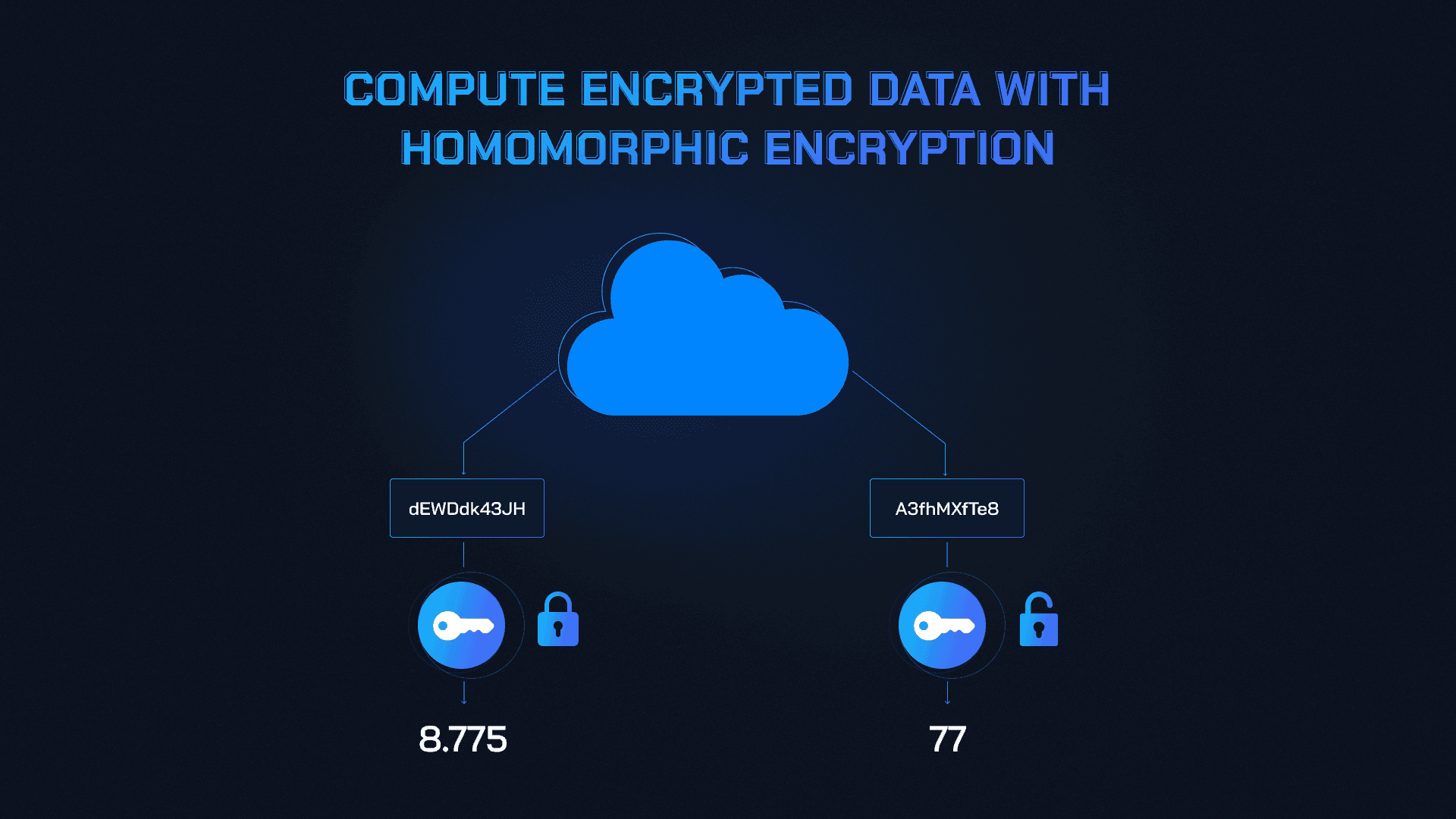
In the evolving landscape of decentralized finance, FHE encrypted smart contracts emerge as a game-changer, enabling true programmable privacy on EVM-compatible chains. Traditional smart contracts expose all data on public ledgers, deterring sensitive applications like private DEXs and sealed-bid auctions. Fully Homomorphic Encryption (FHE) flips this script by allowing computations on encrypted data without decryption, preserving confidentiality while maintaining blockchain's composability and verifiability.
Fhenix leads this charge as an Ethereum L2 powered by FHE rollups and coprocessors, delivering on-chain confidential logic. Their tools, including the FHE Solidity library and CoFHE, let developers write familiar EVM code that processes encrypted inputs seamlessly. Lunarys complements this with Zama's FHE tech for confidential DEXs, where order books and trades stay hidden from prying eyes. Zama's own public token auction via encrypted sealed-bid mechanisms proves FHE's real-world punch, ensuring bids remain secret until reveal time.
Decoding FHE: The Cryptographic Backbone of Programmable Privacy
At its core, FHE permits arithmetic operations on ciphertexts that yield encrypted results matching plaintext computations. Unlike zero-knowledge proofs, which verify without revealing, FHE executes full programs privately. This programmable privacy FHE unlocks encrypted smart contracts on EVM, where contracts can match orders, compute auctions, or aggregate data without exposing inputs.
Consider a private DEX: users submit encrypted orders; the contract homomorphically compares prices and sizes to match trades, outputting only commitments. No front-running, no MEV exploitation. Fhenix's decomposable BFV scheme optimizes this for exact integer ops, vital for token amounts and prices. Their manifesto eyes Ethereum's $100 trillion future, powered by such confidential compute.
Key FHE Advantages for Private DEXs
- Confidentiality: Data stays encrypted end-to-end on-chain during computation, enabling private DEXs like Lunarys (using Zama FHE) and sealed-bid auctions like Zama's token auction.

- Composability: Enables seamless integration with Ethereum apps without sacrificing privacy, as in Fhenix's fully composable encrypted computation.
- EVM Compatibility: Runs on EVM chains with Solidity support via Fhenix FHE libraries and OpenZeppelin's secure FHEVM tools.

- Scalability via Coprocessors: Boosts efficiency with off-chain FHE compute like Fhenix's CoFHE coprocessor, ideal for high-throughput private DEXs and auctions.
Pioneering Projects: Fhenix, Lunarys, and Zama on EVM
Fhenix stands out with EVM compatibility, integrating encrypted computation via Arbitrum tech for private logic without silos. Developers deploy standard Solidity augmented with FHE intrinsics, achieving full composability. Lunarys' docs detail building encrypted order books, leveraging OpenZeppelin's secure libraries for FHEVM to audit-proof contracts. Zama's auction demo showcases end-to-end encryption: bids encrypt client-side, auction contract tallies homomorphically, reveals only winners.
These aren't hypotheticals. Fhenix's R and amp;D yields breakthroughs like efficient FHE for Web3, partnering for confidential DeFi foundations. Challenges persist, chiefly performance; FHE ops are computationally heavy, but coprocessors offload this, slashing gas while preserving decentralization. For auctions, this means verifiable randomness in winner selection without bid leaks, ideal for high-stakes NFT or token sales.
Architectural Edge: From Encryption to Execution on EVM
Implementing encrypted smart contracts EVM demands rethinking execution. FHEVM variants, like those from Zama and Fhenix, extend the EVM with native FHE opcodes. A contract encrypts inputs using public keys, stores ciphertexts on-chain, and invokes homomorphic gates for logic. Outputs decrypt selectively via private keys held by users or oracles.
Explore FHE's role in Ethereum confidential contracts. In a confidential DEX, matching engines use threshold decryption for aggregates, revealing only net flows. Auctions benefit from multi-party computation hybrids, ensuring collusion resistance. OpenZeppelin's FHEVM libs provide audited primitives, lowering the barrier for production-grade apps.
This architecture scales via L2s like Fhenix, where FHE rollups batch proofs off-chain, settling encrypted states on Ethereum. Early adopters report 100x privacy gains over mixers, with auditability intact. As VCs flock to FHE, projects like these signal a shift toward confidential DEX FHE dominance.
Armed with these architectural insights, developers can now transition from theory to practice, crafting FHE encrypted smart contracts that power real applications. Fhenix's FHE Solidity library simplifies this, exposing homomorphic operations as familiar opcodes, while Zama's FHEVM stack offers drop-in EVM extensions for encrypted logic.
Developer's Playbook: Crafting Confidential DEXs and Auctions
To build a confidential DEX FHE, start with encrypted order submission. Users encrypt price and quantity client-side using Fhenix public keys, then submit ciphertexts to the order book contract. The matching engine homomorphically evaluates bids against asks, executing swaps only on valid matches without exposing details. This thwarts predatory strategies, fostering fairer markets.
Deploy FHE Sealed-Bid Auction on Fhenix Testnet


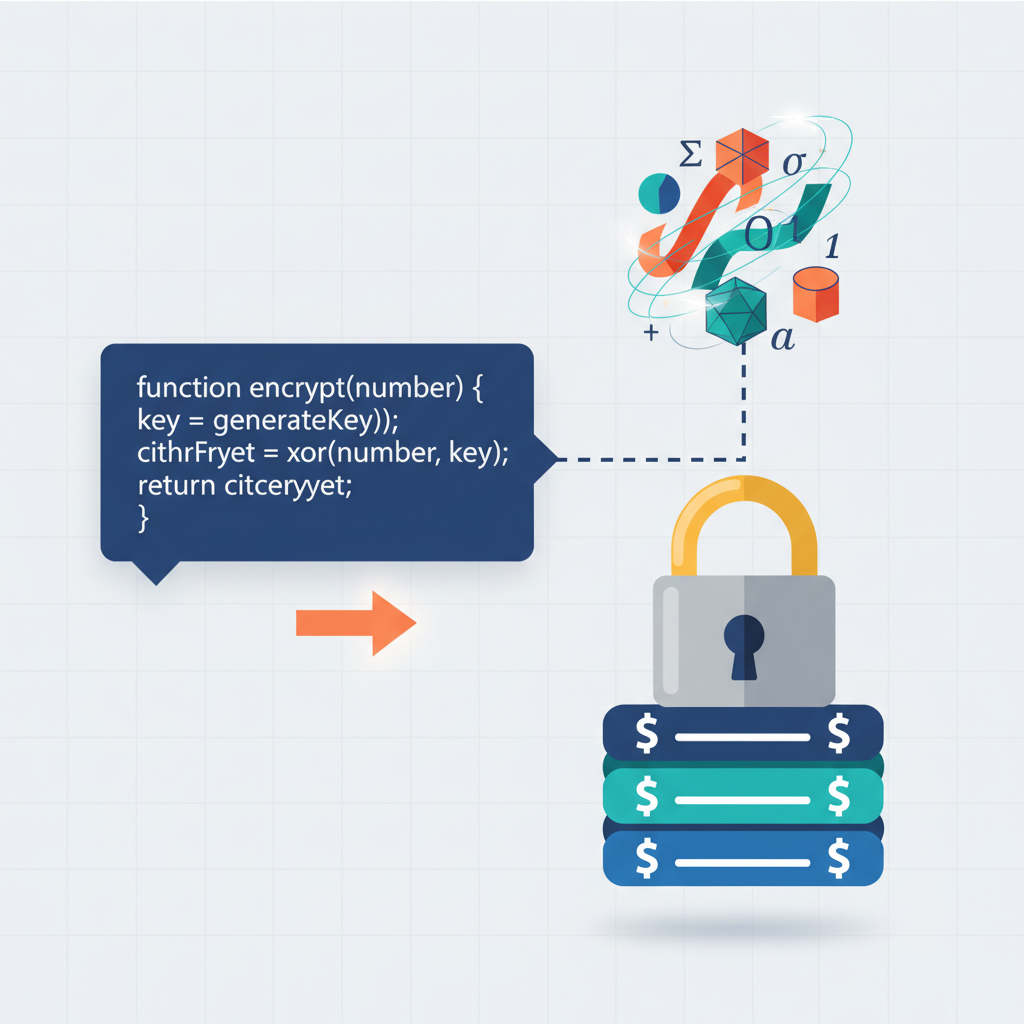
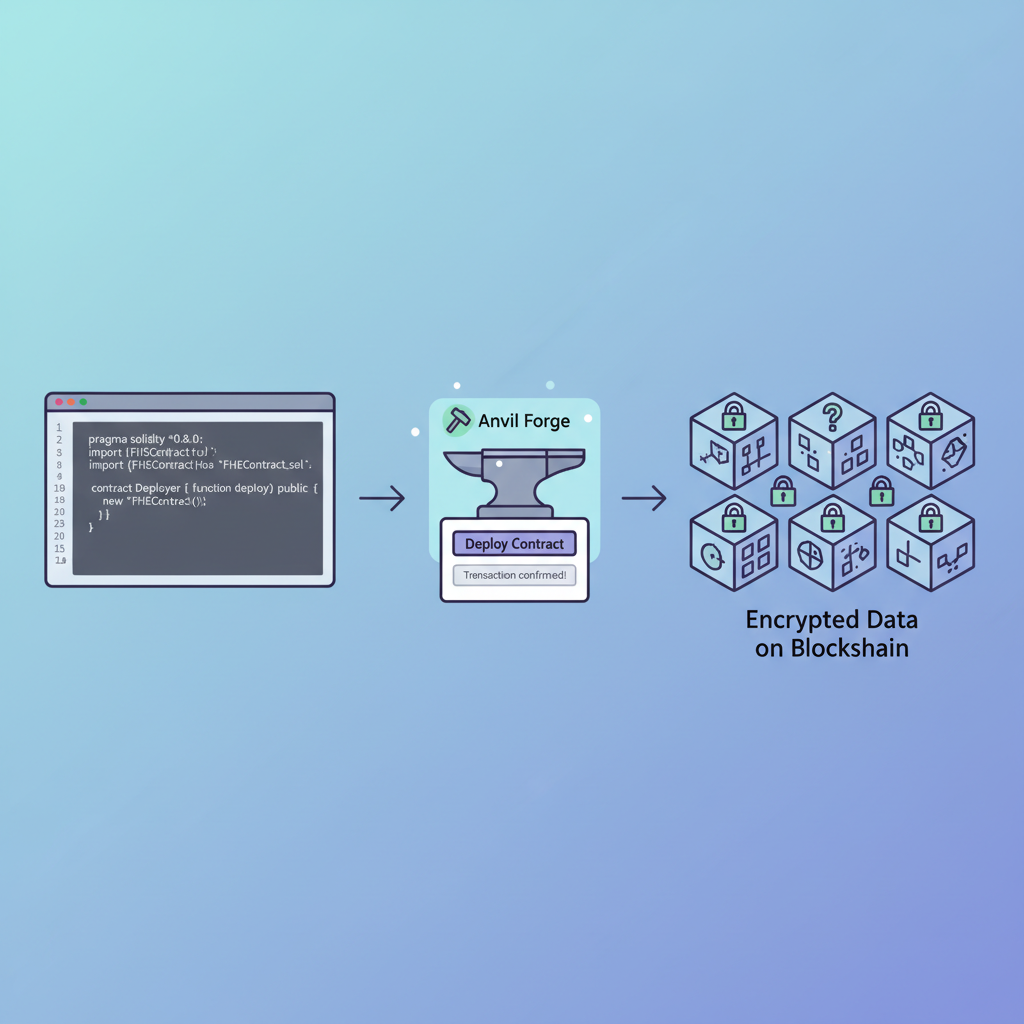

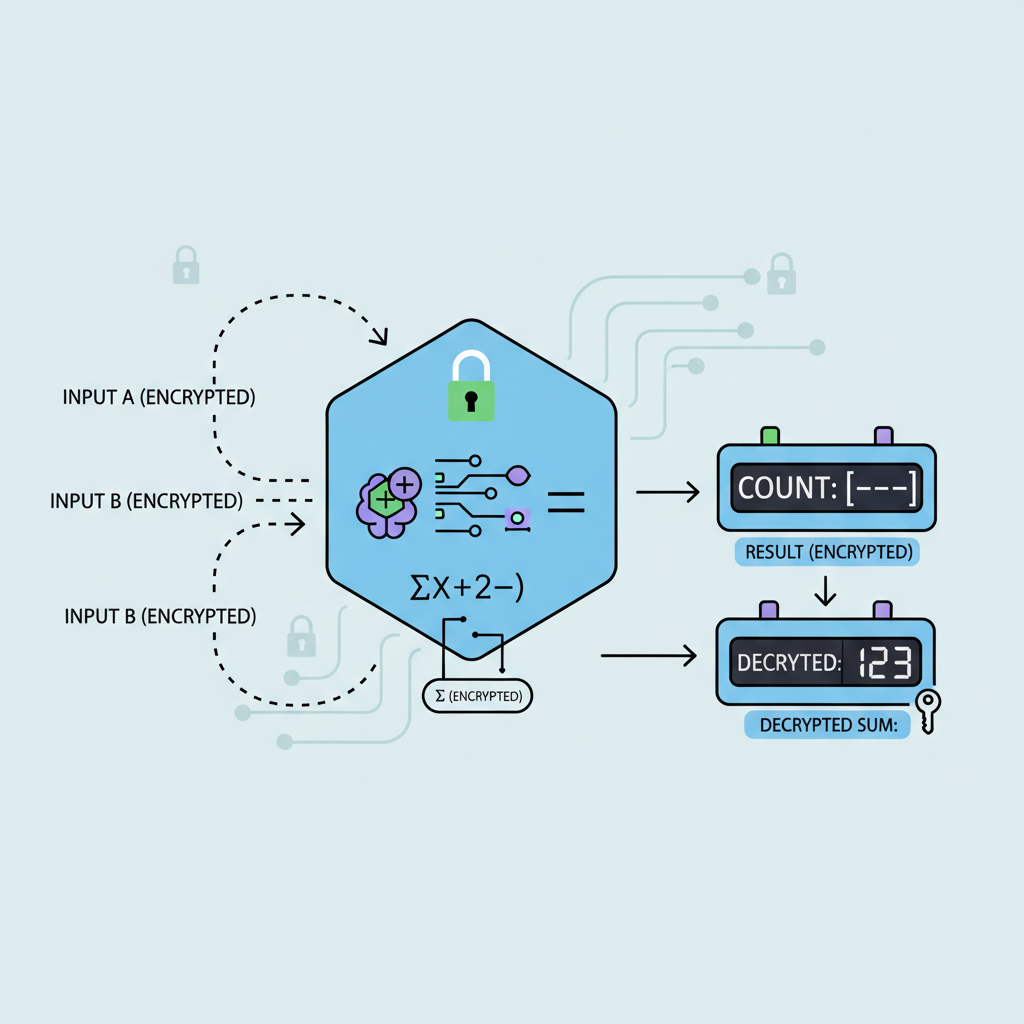

For private auctions blockchain FHE, the workflow mirrors this: bidders encrypt offers, the contract aggregates via homomorphic addition for total commitments, then decrypts only the highest bid post-deadline. Zama's token auction exemplified this, maintaining bid secrecy amid public scrutiny.
Follow this developer guide for encrypted smart contracts on Ethereum. Lunarys pushes boundaries further, integrating order matching with liquidity pools under encryption, all verifiable on-chain.
Solidity Implementation: Homomorphic Price Comparison for Private DEX Matching
To enable private order matching in a DEX, we use fully homomorphic encryption (FHE) via the FHEVM library. This allows the smart contract to compare encrypted buy and sell prices without decrypting the underlying values, ensuring bidder privacy. The `canMatch` function performs a homomorphic subtraction and decrypts only the result.
```solidity
// SPDX-License-Identifier: MIT
pragma solidity ^0.8.19;

import {FhevmLib} from "@fhevm/fhevm.sol";

contract PrivateDEXMatcher {
    using FhevmLib for *;

    struct EncryptedOrder {
        FhevmLib.encrypteduint64 price;
        address trader;
    }

    mapping(uint256 => EncryptedOrder) public buyOrders;
    mapping(uint256 => EncryptedOrder) public sellOrders;

    /// @notice Submits an encrypted buy order
    /// @param orderId Unique identifier for the order
    /// @param encryptedPrice Calldata-encoded encrypted price
    function submitBuyOrder(uint256 orderId, bytes calldata encryptedPrice) external {
        FhevmLib.encrypteduint64 memory encPrice = FhevmLib.newEncrypted(encryptedPrice);
        buyOrders[orderId] = EncryptedOrder(encPrice, msg.sender);
    }

    /// @notice Submits an encrypted sell order
    /// @param orderId Unique identifier for the order
    /// @param encryptedPrice Calldata-encoded encrypted price
    function submitSellOrder(uint256 orderId, bytes calldata encryptedPrice) external {
        FhevmLib.encrypteduint64 memory encPrice = FhevmLib.newEncrypted(encryptedPrice);
        sellOrders[orderId] = EncryptedOrder(encPrice, msg.sender);
    }

    /// @notice Homomorphically checks if buy price >= sell price
    /// @dev Decrypts only the comparison result, not individual prices
    /// @param buyOrderId ID of the buy order
    /// @param sellOrderId ID of the sell order
    /// @return match True if buy price meets or exceeds sell price
    function canMatch(uint256 buyOrderId, uint256 sellOrderId) external view returns (bool match) {
        FhevmLib.encrypteduint64 memory buyPrice = buyOrders[buyOrderId].price;
        FhevmLib.encrypteduint64 memory sellPrice = sellOrders[sellOrderId].price;

        // Homomorphic subtraction: buyPrice - sellPrice
        FhevmLib.encrypteduint64 memory diff = buyPrice.sub(sellPrice);

        // Decrypt the difference and compare to zero
        uint64 decryptedDiff = FhevmLib.decrypt(diff);
        match = decryptedDiff >= 0;
    }
}
```
This approach scales to complex matching logic, such as multi-order auctions or Dutch auctions, where intermediate computations remain encrypted. Integration with FHEVM requires pre-deployed encryption keys and client-side encryption of inputs.
Here's a distilled example in Solidity augmented with FHE intrinsics:
Performance remains the linchpin. Current FHE schemes like Fhenix's decomposable BFV handle exact integers efficiently, but bootstrapping noise limits depth. Coprocessors mitigate this, offloading heavy lifts to specialized hardware, yielding gas savings north of 90% on L2s. Scalability improves with threshold FHE, distributing decryption keys to prevent single points of failure.
Overcoming Hurdles: Gas, Noise, and Adoption
Gas costs and ciphertext expansion pose tangible barriers. A single homomorphic multiplication might eclipse 10,000 gas, yet optimizations like lazy bootstrapping and palletizing multiple ops per ciphertext slash this. Fhenix's Arbitrum integration batches computations off-chain, settling compact proofs on Ethereum, balancing privacy with throughput.
Adoption hinges on tooling. OpenZeppelin's FHEVM libraries furnish audited primitives for access control and randomness, crucial for auctions. Interoperability shines too: FHE contracts compose with plain EVM ones, piping encrypted outputs to DeFi primitives seamlessly.

Risks like chosen-ciphertext attacks demand rigorous key management, but hybrid ZK-FHE schemes emerging from Fhenix R and amp;D fortify resilience. Early metrics impress: Lunarys reports sub-second matching latency on testnets, positioning encrypted smart contracts EVM for mainnet parity.
Venture interest underscores momentum, with FHE topping VC radars for its moat against regulatory prying. Projects proliferate, from confidential lending to private DAOs, all underpinned by programmable privacy FHE.
As Ethereum L2s mature, Fhenix rollups herald a confidential compute layer, unlocking sealed ecosystems where DEXs hum privately and auctions crown victors discreetly. Developers, equip your Solidity with FHE libraries today; the $100 trillion encrypted future beckons, one homomorphic op at a time.




No comments yet. Be the first to share your thoughts!