

Ethereum’s transparent architecture has revolutionized decentralized applications, but it leaves a critical gap for organizations and users who require privacy. Sensitive data, from financial transactions to personal identifiers, is fully exposed on-chain. This limitation has stymied adoption in sectors like enterprise finance, healthcare, and regulated industries where confidentiality is non-negotiable. Fully Homomorphic Encryption (FHE) is poised to change this paradigm by enabling computation on encrypted data, without ever revealing the underlying information.
What Is Fully Homomorphic Encryption and Why Does It Matter?
Fully Homomorphic Encryption is a cryptographic breakthrough that allows arbitrary computations to be performed directly on ciphertexts. In practical terms, it means that smart contracts can process user inputs and maintain state without ever decrypting the data. The result: sensitive values remain confidential throughout their lifecycle, yet the blockchain’s consensus mechanism still verifies the computation’s correctness.
This property is particularly significant for Ethereum, where default transparency exposes all contract logic and storage. With FHE, developers can build truly private DeFi protocols, voting mechanisms, and identity systems, expanding Ethereum’s reach into domains previously out of bounds due to privacy concerns.
Pioneering Implementations: fhEVM and Beyond
The push for confidential smart contracts has moved quickly from theory to practice. Several open-source projects are making FHE integration with Ethereum a reality:
Key Projects Powering FHE Smart Contracts on EVM Chains
- Zama's fhEVM: Zama has developed fhEVM, a fully homomorphic encryption-enabled Ethereum Virtual Machine. It allows developers to write confidential smart contracts in Solidity, supporting computations directly on encrypted data while maintaining compatibility with existing Ethereum tools and infrastructure.

- Fhenix: Fhenix is building an Ethereum Layer 2 solution leveraging FHE rollups and coprocessors. It enables confidential smart contracts by processing encrypted data off-chain and submitting proofs to Ethereum, combining privacy with scalability. Fhenix is fully EVM and Solidity compatible.

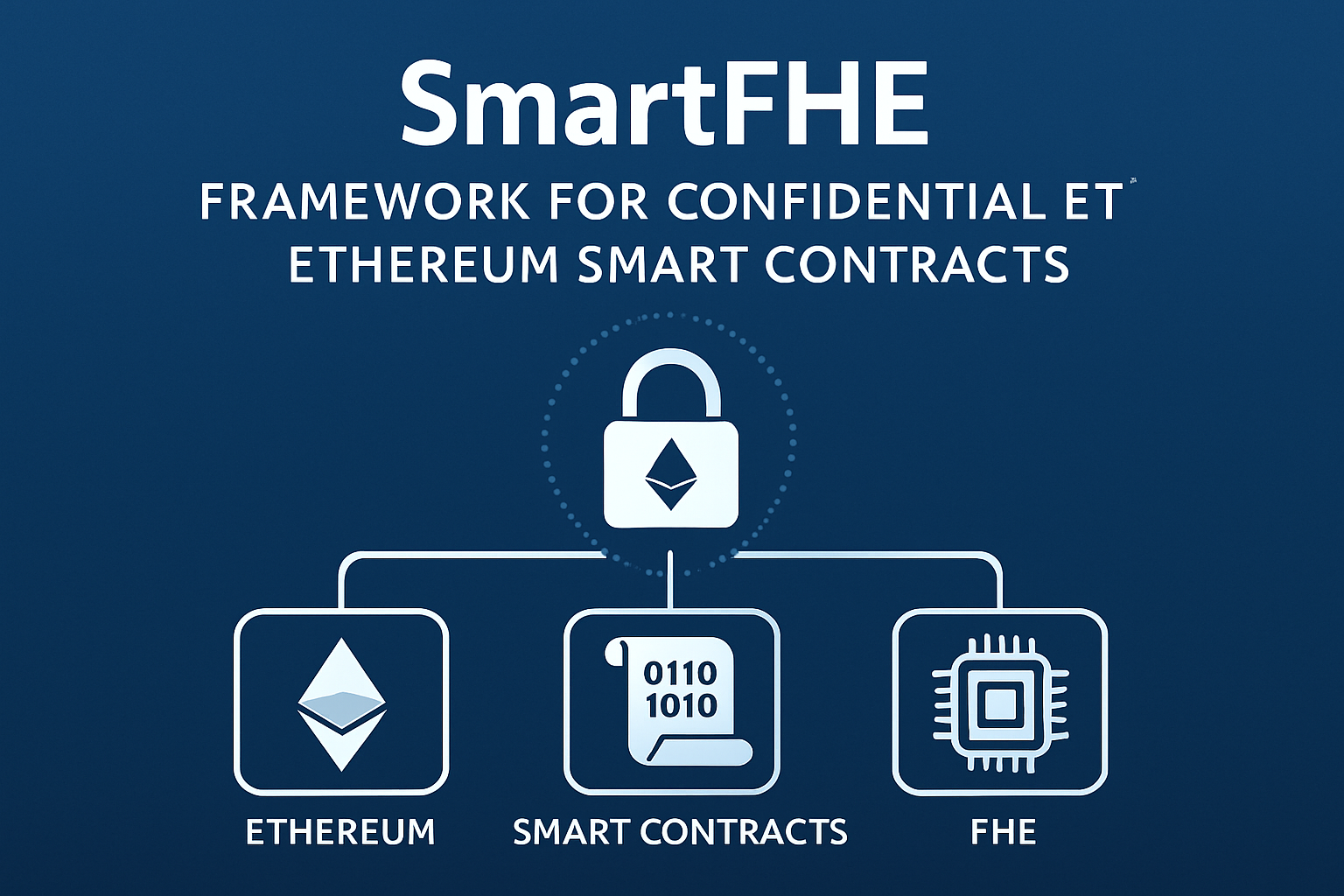
- smartFHE Framework: The smartFHE framework proposes a method for supporting private smart contracts on Ethereum using FHE. It enables miners to compute on encrypted data, reducing user-side computational requirements and facilitating privacy-preserving applications.
Zama’s fhEVM stands at the forefront. It extends the Ethereum Virtual Machine (EVM) with native support for encrypted computation via FHE primitives. Developers can write Solidity contracts using encrypted integer types that function much like their standard counterparts but operate entirely over ciphertexts. This preserves compatibility with existing tooling while unlocking privacy-by-default workflows. For technical deep-dives and code samples, Zama provides detailed documentation (zama.ai/fhevm) and Solidity libraries (zama-ai/fhevm-solidity).
Fhenix, meanwhile, takes a Layer 2 approach by leveraging FHE rollups and coprocessors to enable scalable confidential computation off-chain before submitting proofs back to Ethereum mainnet (fhenix.net). This design reduces gas costs while maintaining rigorous privacy guarantees.
The Mechanics: How Confidential Computation Works in Practice
The core innovation behind fully homomorphic encryption smart contracts lies in their ability to handle encrypted inputs transparently:
- User Data Encryption: Users encrypt their inputs locally before submitting them to the blockchain.
- Encrypted State Management: Smart contracts receive only ciphertexts as inputs and maintain all internal variables in encrypted form.
- Computation Over Ciphertexts: Contract logic executes mathematical operations, addition, multiplication, directly on ciphertexts using specialized cryptographic libraries like those provided by Zama or Fhenix.
- Result Decryption: Only authorized parties possessing decryption keys can reveal final outputs or intermediate states.
This model ensures that even validators or miners executing contract code cannot glean any information about the underlying data, a radical departure from traditional EVM execution models.
Main Use Cases: Unlocking Privacy-First Applications on Ethereum
The integration of FHE into Ethereum’s ecosystem unlocks several high-value applications where privacy is paramount:
Top Confidential DeFi Use Cases Enabled by FHE
- Private Lending and Borrowing Protocols: FHE enables DeFi platforms to process loan applications and manage collateral without revealing sensitive financial details, protecting user privacy while ensuring trustless execution.

- Confidential Automated Market Makers (AMMs): With FHE, AMMs can obscure trade sizes, strategies, and liquidity positions, preventing front-running and preserving trader anonymity on platforms like Uniswap or Curve.

- Encrypted On-Chain Asset Management: Asset managers can deploy private investment strategies and portfolio rebalancing logic, keeping allocations and performance data encrypted from competitors and the public.

- Private Decentralized Insurance: FHE allows insurance protocols to process claims and risk assessments using encrypted user data, maintaining confidentiality for sensitive personal and financial information.

- Confidential Stablecoin Transactions: Stablecoin platforms can leverage FHE to enable private transfers and balances, ensuring that transaction amounts and counterparties remain confidential while maintaining regulatory compliance.

For example, in confidential DeFi lending platforms, loan amounts, collateral values, and borrower identities remain hidden from public view while still allowing trustless settlement. Similarly, DAOs can implement fully private voting systems where ballots are cast as ciphertexts but tallied accurately without revealing individual choices (smartFHE framework proposal). Secure identity management becomes possible as well, users can prove attributes or compliance without exposing raw personal data.
These privacy guarantees are not merely theoretical. Early deployments of fhEVM contracts are already demonstrating confidential auctions, sealed-bid tenders, and private asset swaps, applications that were once impossible on transparent blockchains. By leveraging encrypted Solidity types, developers can create smart contracts where balances, bids, or votes remain invisible to everyone except authorized parties.
Yet the journey from research to robust production systems is ongoing. Performance remains a significant consideration: FHE computations are inherently more resource-intensive than plaintext operations. For instance, as noted in recent cryptographic studies, division and rational number operations over ciphertexts are especially costly compared to basic integer arithmetic. This drives ongoing optimization efforts focused on both software libraries and hardware acceleration solutions.
Developer Experience: Building with Encrypted Solidity Types
One of the most compelling advances is the abstraction layer provided by libraries such as zama-ai/fhevm-solidity. Developers can now work with encrypted integers in Solidity much like standard uint256 or int128 types, while the underlying FHE machinery handles ciphertext manipulation transparently. This dramatically lowers the barrier to entry for confidential DeFi contracts and other privacy-first dApps.
- Encrypted Input Handling: Users encrypt data client-side before sending transactions.
- Ciphertext Processing: Smart contracts operate exclusively on encrypted values using familiar Solidity syntax.
- Key Management: Only designated keyholders (e. g. , users or trusted oracles) can decrypt results post-execution.
- EVM Compatibility: Existing tools like Hardhat and Remix remain usable for development and debugging.
This seamless developer experience is crucial for adoption, ensuring that privacy need not come at the expense of usability or composability within Ethereum’s broader ecosystem.
What’s Next? Scaling Confidential Computation on Ethereum
The future of fully homomorphic encryption smart contracts will be shaped by continued progress across several fronts:
Key Challenges and Future Directions for FHE on Ethereum
- Computational Overhead Remains a Major Bottleneck: Fully Homomorphic Encryption (FHE) operations are significantly more resource-intensive than standard cryptographic methods, resulting in higher latency and increased gas costs for confidential smart contracts. Ongoing research focuses on optimizing FHE algorithms and exploring hardware acceleration to make these computations more practical for real-world Ethereum applications.

- Integration Complexity with Existing Blockchain Infrastructure: Incorporating FHE into Ethereum requires careful architectural design to maintain security, scalability, and compatibility with the Ethereum Virtual Machine (EVM). Projects like Zama's fhEVM and Fhenix are pioneering solutions, but seamless integration and developer accessibility remain active areas of development.

- Key Management and Secure Access Control: Managing encryption keys in a decentralized, trustless environment is a critical challenge. Ensuring that only authorized parties can decrypt sensitive data, while preventing single points of failure, is essential for maintaining the confidentiality and integrity of FHE-powered smart contracts.

- Developer Tooling and Ecosystem Maturity: The current ecosystem for FHE-powered confidential computation is still maturing. While libraries like fhevm-solidity provide foundational tools, broader support, documentation, and integration with popular developer frameworks are needed to lower the barrier to entry and foster widespread adoption.

- Future Directions: Enhanced Performance and New Use Cases: Research into more efficient FHE schemes, Layer 2 solutions (such as FHE rollups by Fhenix), and hybrid approaches combining FHE with other privacy technologies may unlock broader applications. Potential future use cases include confidential DeFi protocols, private DAOs, and secure on-chain identity management.

Scalability solutions, such as Fhenix’s FHE rollups and Zama’s protocol-level optimizations, are expected to reduce latency and gas costs associated with ciphertext operations. Meanwhile, improved key management frameworks will help mitigate risks around decryption authority in decentralized environments. As these technical hurdles fall, we can anticipate a new generation of confidential DeFi protocols, ranging from private derivatives markets to compliance-friendly stablecoins, emerging on Ethereum and beyond.
The integration of FHE into mainstream blockchain development signals a paradigm shift: privacy no longer stands in opposition to transparency but instead coexists through cryptographic assurances. As projects like fhEVM mature, expect confidential smart contract computation to move from niche pilot programs into core infrastructure for enterprise-grade blockchain applications.




No comments yet. Be the first to share your thoughts!