

In the high-stakes arena of decentralized finance on Ethereum, where every transaction lays bare under the public gaze, encrypted smart contracts with Fully Homomorphic Encryption (FHE) stand as a game-changer for private DeFi. Imagine executing complex trades, lending protocols, or liquidations without exposing balances, rates, or positions to the world. FHE makes this possible by letting smart contracts crunch numbers on ciphertext alone, preserving confidentiality end-to-end. This isn't just theoretical; projects like Fhenix and Zama are turning it into deployable reality, bridging the gap between privacy ideals and practical blockchain engineering.

FHE's power lies in its ability to perform additions, multiplications, and even comparisons on encrypted data without decryption. Traditional privacy tools like zk-SNARKs shine for proofs but falter on general computation. FHE, however, unlocks arbitrary operations, making it ideal for dynamic DeFi apps where rules evolve. Yet, as a strategist who's navigated 18 years of market volatility, I caution: this tech demands patience. Performance lags behind plaintext Ethereum, but optimizations from threshold networks and coprocessors are closing the gap swiftly.
Fhenix and Zama: Pioneering FHEVM for Ethereum Developers
Leading the charge, Fhenix delivers the CoFHE coprocessor, an off-chain service that supercharges EVM contracts with encrypted computations. Their FHE. sol library introduces encrypted integer types, think euint8 to euint256: with native homomorphic ops. Developers import it, swap plaintext vars for encrypted ones, and voilà: confidential logic flows seamlessly. Pair this with their Threshold Decryption Network for controlled reveals, and you've got enterprise-grade privacy without sacrificing composability.
Zama's fhEVM takes a bolder stride, embedding FHE directly into Solidity. No crypto PhD required; write familiar code, but with encrypted primitives. Their FHESwap protocol exemplifies this, porting Uniswap V2's AMM into a fully confidential DEX. Reserves, swaps, even fees stay hidden, thwarting front-running and MEV extraction. In my view, this democratizes FHE blockchain privacy, letting mid-tier teams build confidential smart contracts that rival centralized vaults.
Core Challenges in FHE-Enabled Private DeFi
Don't get swept up in the hype without confronting realities. Computational overhead remains FHE's Achilles' heel, expect 100x-1000x slowdowns on complex ops. Fhenix mitigates via off-chain coprocessing, but gas costs still spike. Security demands vigilance too; OpenZeppelin's FHEVM guide flags pitfalls like key mismanagement or side-channel leaks in encryption patterns. I advocate a conservative rollout: start with simple confidential transactions, benchmark rigorously, then scale to lending or vaults.
Regulatory tightropes add intrigue. FHE shields data beautifully, but compliant reveals via threshold decryption are essential for institutional adoption. Private lending protocols, for instance, encrypt loan terms and collateral, computing health factors homomorphically to trigger MEV-proof liquidations. No more sniper bots peering at positions. Vault managers execute strategies in secret, disclosing only to auditors. This selective transparency? It's the prudent path to sustainable homomorphic encryption DeFi.
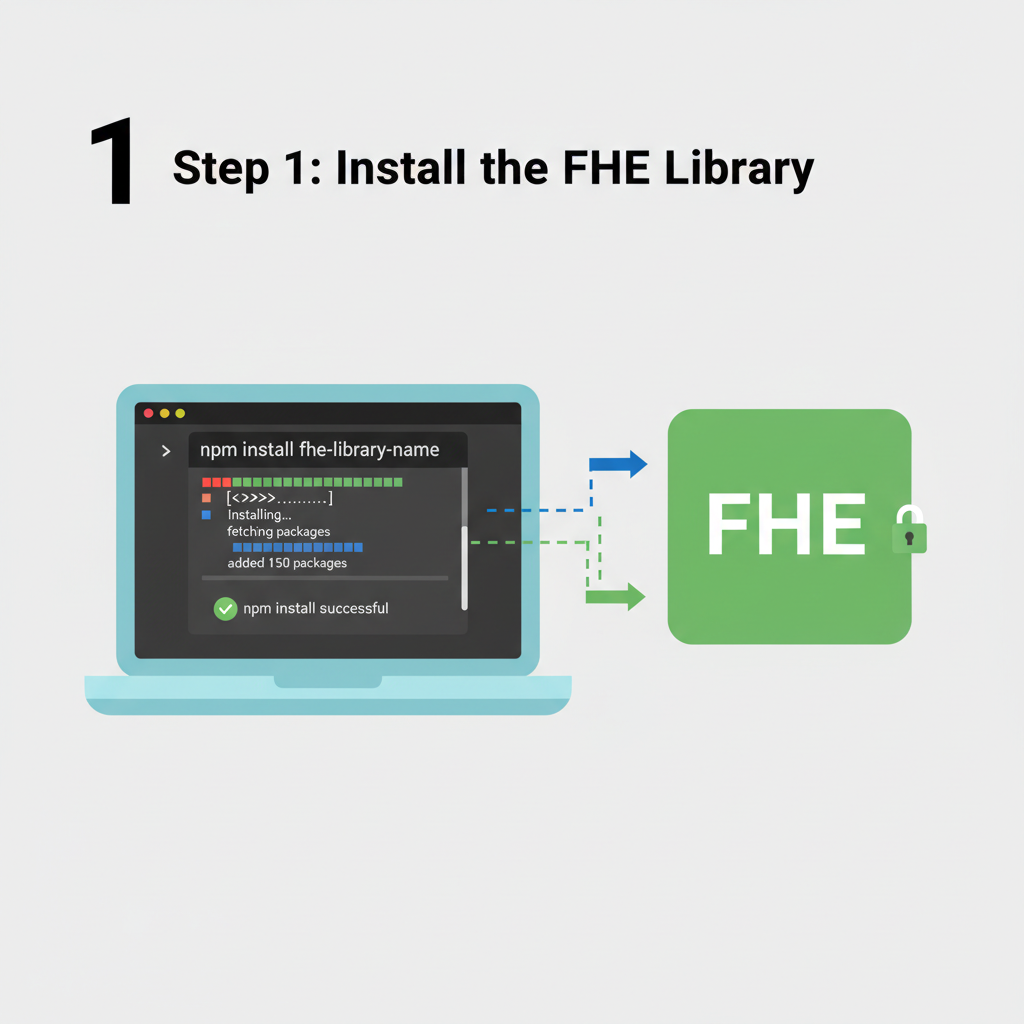
To dive into encrypted smart contracts FHE implementation, equip your toolkit wisely. Begin with Remix IDE or Hardhat for Solidity, but integrate Fhenix's testnet or Zama's fhEVM dev stack. Install @fhenix/fhevm via npm, configure a wallet like MetaMask for their Sepolia variant, and fund with test FHENC tokens. QuickNode's Ethereum overview reminds us: smart contracts thrive on reliable nodes, so layer in an RPC endpoint optimized for FHE payloads.
Best practices from Codezeros and LeewayHertz apply here, modularize code, audit encrypted ops separately, and simulate decryption leaks. Deploy a starter contract: encrypt inputs client-side with TFHE keys, relay to chain, process homomorphically. For deeper guidance on enabling confidential contracts, explore this foundational resource. Next, we'll craft a private lending snippet, but first, grasp these foundations to avoid costly missteps in private DeFi Ethereum.
With your environment primed, let's construct a confidential lending contract that encrypts borrower collateral, loan amounts, and health factors. This blueprint draws from Fhenix's encrypted smart contracts FHE patterns, replacing uint256 with euint256 for homomorphic arithmetic. Borrowers deposit encrypted collateral, lenders fund anonymously, and liquidations fire only when encrypted thresholds breach, all without exposing positions to MEV predators. Prudence dictates: prototype on testnets first, where gas simulations reveal true costs before mainnet commitment.
Hands-On Tutorial: Deploying Confidential Lending on Fhenix Testnet
Unlock Private DeFi: Deploy FHE-Encrypted Lending Contract on Ethereum






Once deployed, interact via Web3. js or ethers. js: encrypt inputs client-side using TFHE-RS library, submit transactions, and decrypt outputs selectively. For a lending pool, the contract might compute healthFactor = collateralValue * price/debt entirely encrypted, triggering liquidation if below 1.1. This MEV-proof design fortifies private DeFi Ethereum against exploitation, a strategic edge in crowded markets.
Confidential Lending Contract: Encrypted Health Factor and Liquidation Logic
To enable private DeFi lending, we implement a Solidity smart contract using the fhEVM library for Fully Homomorphic Encryption (FHE). Collateral and debt remain encrypted on-chain (as `euint256`), allowing homomorphic computation of the health factor—(collateral / debt) * 100—without decryption. Liquidation checks compare this encrypted value against a threshold, preserving user privacy while enforcing protocol solvency.
```solidity
pragma solidity ^0.8.19;

import {euint256, ebool} from "@matterlabs/fhevm-solidity/contracts/types.sol";
import {TFHE} from "@matterlabs/fhevm-solidity/contracts/TFHE.sol";

contract ConfidentialLending {
    mapping(address => euint256) public collateral;
    mapping(address => euint256) public debt;
    uint256 public constant LIQUIDATION_THRESHOLD = 125; // 1.25x collateralization ratio

    /// @notice Deposit encrypted collateral
    function depositCollateral(euint256 encryptedCollateral) external {
        collateral[msg.sender] = TFHE.add(collateral[msg.sender], encryptedCollateral);
    }

    /// @notice Borrow encrypted amount, increasing debt
    function borrow(euint256 encryptedAmount) external {
        require(isHealthy(msg.sender), "Position not healthy");
        debt[msg.sender] = TFHE.add(debt[msg.sender], encryptedAmount);
    }

    /// @notice Compute health factor homomorphically: (collateral / debt) * 100
    function getHealthFactor(address user) public view returns (euint256) {
        euint256 col = collateral[user];
        euint256 deb = debt[user];
        euint256 ratio = TFHE.div(col, deb);
        return TFHE.mul(ratio, euint256.wrap(100));
    }

    /// @notice Check if position is liquidatable via homomorphic comparison
    function isLiquidatable(address user) public view returns (bool) {
        euint256 health = getHealthFactor(user);
        euint256 threshold = euint256.wrap(LIQUIDATION_THRESHOLD);
        ebool unhealthy = TFHE.lt(health, threshold);
        return TFHE.decrypt(unhealthy);
    }

    /// @notice Internal healthy check
    function isHealthy(address user) public view returns (bool) {
        return !isLiquidatable(user);
    }
}
```
This design strategically balances privacy and functionality: homomorphic operations execute efficiently on encrypted data, enabling permissionless liquidation checks. By avoiding oracle dependencies for user positions, it mitigates manipulation risks and positions the protocol for scalable, confidential DeFi on Ethereum.
Testing elevates from toy examples to battle-tested protocols. Leverage Hardhat forks of Fhenix Sepolia, fuzz encrypted inputs with foundry, and audit via OpenZeppelin's FHEVM checklist. Common traps? Mismatched key schemes or overflow in homomorphic multiplications. My research-driven stance: allocate 30% of dev time to audits, partnering with firms versed in lattice crypto. For comprehensive steps on confidential smart contracts tutorial, reference this developer guide.
Scaling to Production: Performance and Security Optimizations
Production demands ruthless optimization. Fhenix's CoFHE offloads heavy ops, slashing on-chain gas by 90% for swaps or oracles. Batch transactions, use smaller key spaces for non-critical fields, and integrate ZK proofs for lighter verification. FHESwap's Uniswap port proves viability: full AMM logic encrypted, with trades settling privately yet composably. I've seen teams falter here, chasing perfection over iteration; start lean, measure latency, iterate.
Security isn't optional. Threshold decryption ensures no single point leaks data, ideal for FHE blockchain privacy. Yet, quantum threats loom; opt for TFHE variants with post-quantum lattices. Compliance weaves in via oracle-attested reveals, satisfying KYC mandates without blanket transparency. Enterprises eyeing homomorphic encryption DeFi vaults will appreciate this balance, managing treasuries discreetly while auditors peek on demand.
Real-world traction builds momentum. FHESwap DEX hides reserves, curbing arbitrage; private vaults execute yield farms incognito. Lending evolves too: encrypt APYs, match borrowers invisibly, compute risks homomorphically. These aren't hypotheticals; Fhenix's encrypted lending blog details live prototypes outperforming transparent rivals in adversarial simulations.
As Ethereum scales via danksharding, FHE matures alongside. Coprocessors evolve, libraries standardize, and dev tools intuit encrypted flows. My counsel, forged in volatile cycles: invest now in FHE literacy. It future-proofs DeFi against surveillance economies, delivering sustainable alpha through unassailable privacy. Deploy thoughtfully, and watch your protocols thrive in Ethereum's confidential frontier.




No comments yet. Be the first to share your thoughts!