


In the transparent ledger of Ethereum, every transaction lays bare financial intentions, balances, and strategies to the world. This visibility fuels innovation in DeFi but invites front-running, MEV exploitation, and privacy erosion. Enter Fhenix encrypted smart contracts, a breakthrough harnessing Fully Homomorphic Encryption (FHE) to enable confidential DeFi on Fhenix without sacrificing decentralization or EVM compatibility. Fhenix doesn’t merely obscure data; it empowers smart contracts to compute directly on encrypted inputs, yielding private outputs that redefine on-chain privacy.

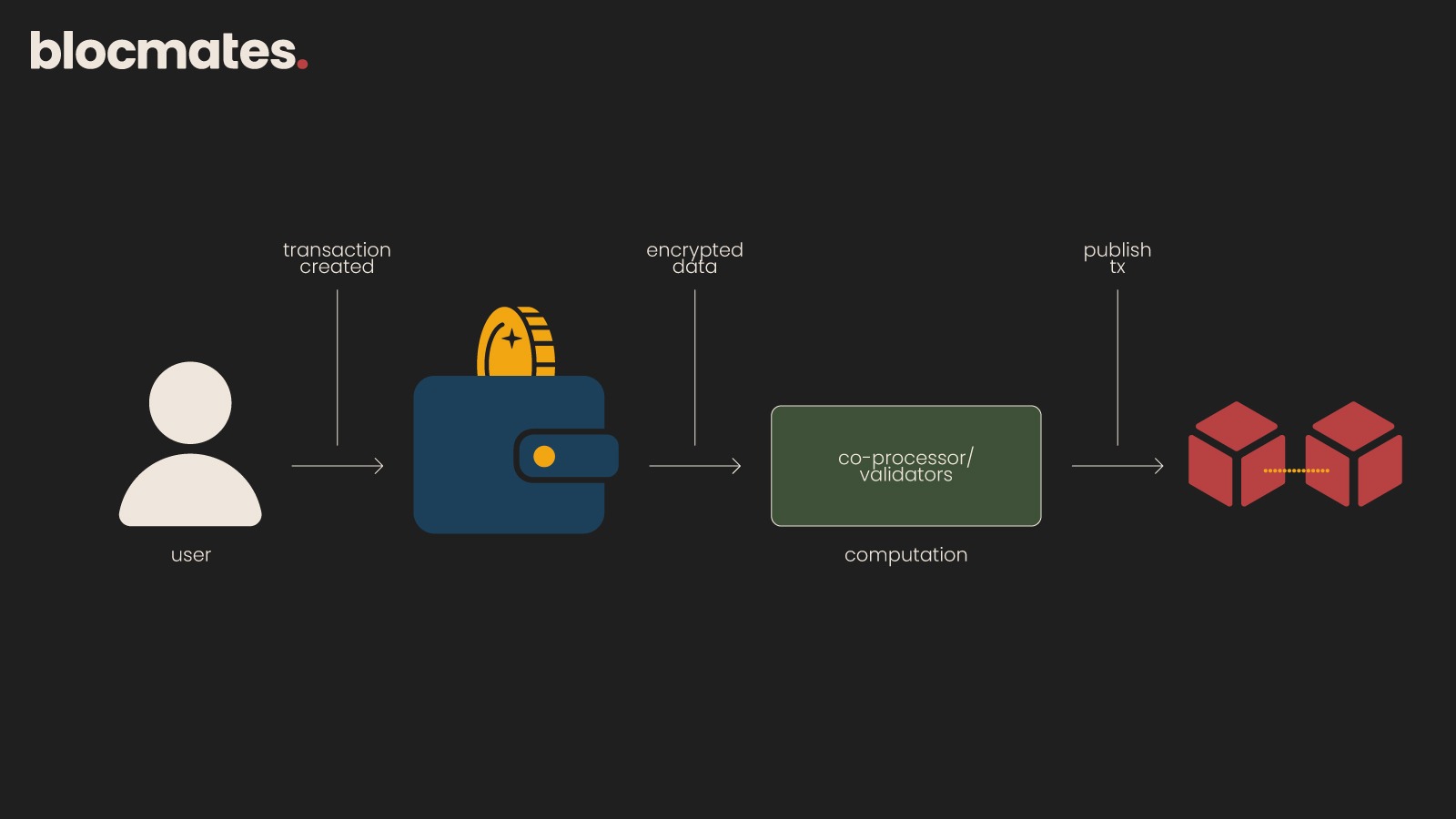
Fhenix’s approach stands out in a crowded privacy landscape. Unlike zero-knowledge proofs, which verify without revealing, FHE allows arbitrary computations on ciphertexts, preserving data confidentiality throughout execution. This unlocks private on-chain computation for complex DeFi primitives like lending protocols and automated market makers, where inputs remain shielded even from validators.
Decoding Fully Homomorphic Encryption for Blockchain
Fully Homomorphic Encryption, the cryptographic holy grail theorized in 1978 and realized in 2009, permits operations on encrypted data that mirror plaintext results upon decryption. In blockchain terms, imagine a smart contract evaluating loan eligibility on salary figures without ever seeing the numbers. Fhenix tailors FHE schemes like TFHE for Ethereum’s constraints, optimizing for gas efficiency and latency.
Their CoFHE protocol, an off-chain computation service, handles the heavy lifting of homomorphic operations outside the chain while settling verifiable results on-chain. This hybrid model sidesteps FHE’s historical performance hurdles, achieving decryption speeds via a novel Threshold Network that distributes keys across nodes. Developers interact seamlessly using Solidity extensions, compiling standard code with FHE libraries to encrypt inputs client-side.
Fhenix enables smart contracts to compute on encrypted data, without ever revealing it. This preserves privacy while maintaining Ethereum compatibility.
Since the Helium testnet launch in mid-2024, builders have deployed live demos showcasing encrypted ETH smart contracts. From confidential payments to shielded stablecoins, these applications run on EVM chains, proving FHE’s viability beyond proofs-of-concept.
Fhenix’s Developer Toolkit: From Solidity to Privacy-Preserving dApps
Fhenix equips developers with production-ready primitives. The FHE Solidity Libraries integrate homomorphic types into familiar syntax, while Cofhe. js handles client-side encryption. Start with their GitHub ERC20 tutorial, a scaffold for token contracts where balances stay encrypted.
Sample Encrypted Balance Transfer (Fhenix ERC20)
The Fhenix ERC20 tutorial provides a practical example of confidential token transfers using fully homomorphic encryption (FHE). Balances are stored as encrypted ciphertexts (bytes32), and arithmetic operations like subtraction and addition are performed directly on ciphertexts without decryption. The following Solidity snippet illustrates the core `transfer` function:
```solidity
// SPDX-License-Identifier: MIT
pragma solidity ^0.8.22;

import {FheCircuit} from "@fhenix/contracts/FheCircuit.sol";

contract EncryptedERC20 {
    mapping(address => bytes32) public balances;

    event Transfer(address indexed from, address indexed to, bytes32 value);

    /// @notice Transfers an encrypted amount to the recipient
    /// @dev Performs homomorphic subtraction and addition on encrypted balances
    /// @param to Recipient address
    /// @param encryptedAmount Encrypted transfer amount
    function transfer(address to, bytes32 encryptedAmount) external {
        bytes32 senderBalance = balances[msg.sender];

        // Compute new sender balance homomorphically
        bytes32 newSenderBalance = FheCircuit.fheSub(senderBalance, encryptedAmount);

        // Verify sufficient balance (simplified; production uses proper verification)
        require(FheCircuit.fheLt(newSenderBalance, bytes32(0)) == 0, "Insufficient balance");

        // Update balances atomically
        balances[msg.sender] = newSenderBalance;
        balances[to] = FheCircuit.fheAdd(balances[to], encryptedAmount);

        emit Transfer(msg.sender, to, encryptedAmount);
    }
}
```
Key observations: The `fheSub` and `fheAdd` operations ensure confidentiality, as the EVM processes encrypted data homomorphically. The balance check uses `fheLt` to compare against zero privately. In production, integrate with Fhenix’s verification mechanisms for robustness.
Consider a confidential ERC20: transfers compute homomorphically, revealing only commitments on-chain. Deployment mirrors vanilla Solidity, but with encrypted state transitions verified via zero-knowledge proofs on aggregates. This FHE-enabled paradigm scales to yield farming, where APYs calculate privately, thwarting copycat strategies.
Partnerships amplify reach. Collaborations with Offchain Labs infuse FHE into Arbitrum, targeting sub-second confidential executions. FHE-Rollups, as previewed in Fhenix’s blog, promise sequenced batches of private transactions, blending scalability with secrecy.
Confidential DeFi in Motion: Demos and Early Adopters
Live proofs abound. Encrypted lending protocols simulate collateral checks on hidden positions, outputting approvals sans exposure. Fluton, built atop Fhenix, delivers privacy-native swaps and liquidity pools, where order books evade predatory bots.
Redact Money exemplifies usability: users encrypt ETH client-side, swap into shielded assets, and redeem privately. These aren’t lab curiosities; they’re battle-tested on Helium, with metrics showing throughput rivaling unencrypted peers. By embedding privacy at the computation layer, Fhenix mitigates DeFi’s Achilles heel, positioning privacy-preserving blockchain DeFi as the next evolution.
Yet challenges persist. FHE’s ciphertext expansion demands optimized schemes, and oracle integration for external data requires careful homomorphic aggregation. Fhenix’s Threshold Network mitigates these, but real-world stress tests on mainnet will affirm maturity. Still, the trajectory is compelling: confidential DeFi isn’t a distant promise; it’s deployable today.
Addressing these hurdles requires iterative refinement, and Fhenix’s roadmap prioritizes exactly that. Their Threshold Network already slashes decryption times, outperforming rivals by orders of magnitude through distributed key management. This isn’t theoretical; Helium testnet metrics confirm sub-minute latencies for complex operations, a far cry from FHE’s early days of hour-long computations.
Scaling Privacy: FHE-Rollups and Ecosystem Integrations
Fhenix’s vision extends to FHE-Rollups, a sequencing mechanism that bundles encrypted transactions for efficient on-chain settlement. Detailed in their blog, these rollups compress private state updates into succinct proofs, enabling high-throughput confidential DeFi Fhenix on Ethereum L2s. Paired with Offchain Labs, this integration targets Arbitrum’s ecosystem, where confidential batches could process thousands of shielded swaps per second.
Imagine yield optimizers that privately aggregate user positions across protocols, outputting personalized strategies without leaking allocations. Or prediction markets where bets resolve homomorphically, shielding participant stakes from manipulation. These aren’t hypotheticals; Fhenix’s demos, like encrypted stablecoins and private payments, already simulate them on EVM testnets.
Fhenix’s Core Advantages
-

End-to-end data privacy during computation: Smart contracts process encrypted data without decryption, preserving confidentiality on-chain.
-

Full EVM compatibility: Seamless integration with Ethereum Virtual Machine enables developers to use standard Solidity tools.
-

Threshold decryption: Distributed key scheme enhances censorship resistance and security in decryption processes.
-

Optimized TFHE schemes: Threshold Fully Homomorphic Encryption reduces gas costs for efficient private computations.
-

Client-side encryption via Cofhe.js: Users control encryption locally with the Cofhe.js library before on-chain submission.
Such primitives empower builders to sidestep DeFi’s transparency pitfalls. Front-running thrives on visible orders; with private on-chain computation, intents stay ciphertexts until execution. MEV bots scan mempools in vain, as encrypted inputs defy pattern recognition. This shifts power back to users, fostering fairer markets.
Early adopters validate the stack. Fluton’s privacy-native DEX leverages Fhenix for hidden liquidity pools, where swaps execute without order book leakage. Redact Money streamlines the flow: encrypt ETH, trade shielded assets, decrypt only at redemption. User feedback highlights the seamlessness, with one explorer noting a “surprisingly smooth” interface on Helium.
Hands-On: Deploying Encrypted DeFi Today
Getting started demands minimal friction. Clone the FhenixProtocol ERC20 tutorial from GitHub, a boilerplate for encrypted ETH smart contracts. Extend it with FHE libraries for confidential balances: encrypt transfers client-side, compute additions homomorphically, and emit zero-knowledge commitments on-chain.
Confidential ERC20: Homomorphic Minting and Balance Checks
Fhenix leverages fully homomorphic encryption (FHE) in its fhEVM to enable confidential smart contracts. The following Solidity example, adapted from Fhenix documentation, demonstrates a basic confidential ERC20 token. It uses encrypted integers (`euint256`) to perform homomorphic addition during minting, keeping token amounts and balances private on-chain.
```solidity
pragma solidity ^0.8.20;

import {FheContext} from "@fhenix/contracts/src/FheContext.sol";
import {euint256} from "@fhenix/contracts/src/types/euint256.sol";

contract ConfidentialERC20 is FheContext {
    mapping(address => euint256) private _balances;

    function mint(address to, euint256 amount) public {
        _balances[to] = _balances[to] + amount;
    }

    function balanceOf(address account) public view returns (euint256) {
        return _balances[account];
    }
}
```
Observe the homomorphic addition `_balances[to] + amount` on encrypted values, which computes the sum directly on ciphertexts without decryption. The `balanceOf` function returns an encrypted balance, verifiable only by authorized parties with the private key.
Compile with standard tools, deploy to Helium via Remix or Hardhat. Test encrypted lending: collateral encrypts pre-submission, interest accrues invisibly, liquidation thresholds evaluate blindly. For oracles, aggregate feeds homomorphically to prevent single-point leaks. This workflow mirrors Uniswap forks but with privacy baked in, accelerating encrypted smart contract deployment.
Fhenix’s documentation at fhenix. zone walks through these steps, emphasizing Solidity extensions that abstract FHE complexity. Cofhe. js simplifies frontend integration, letting dApps encrypt inputs without custom crypto libraries. Mainnet looms as testnet TVL climbs, signaling readiness for production-grade privacy-preserving blockchain DeFi.
The stakes for DeFi are profound. Public ledgers bred explosive growth but at privacy’s expense; Fhenix recalibrates the balance. By embedding confidentiality at the computation core, it unlocks institutional-grade applications: private vaults for high-net-worth strategies, compliant lending blind to AML flags until necessary. Regulators eyeing on-chain activity will find encrypted states unpalatable for surveillance, yet verifiable for audits.
Developers, this is your cue. Fork the tutorials, spin up Helium nodes, and prototype confidential AMMs. The privacy edge compounds; early movers capture mindshare in a market ripe for shielded innovation. Fhenix doesn’t just encrypt data; it fortifies DeFi’s foundation against transparency’s double-edged sword, paving a confidential path forward.
About the Author