

In the evolving landscape of decentralized finance in 2026, privacy has become non-negotiable. Public blockchains expose every transaction detail, inviting scrutiny from regulators, hackers, and competitors alike. Enter Miden, the edge blockchain revolutionizing encrypted smart contracts through STARK proofs. This technology promises scalable, verifiable privacy without compromising performance, paving the way for true private DeFi smart contracts. As developers eye mass adoption, Miden’s architecture stands out by blending high throughput with zero-knowledge guarantees.

Miden, spun out from Polygon Labs with $25 million in funding from a16z Crypto in April 2025, now operates independently. Its mainnet launch slated for mid-Q2 2026 marks a pivotal moment for blockchain privacy 2026. Developers can finally build applications that handle sensitive data confidentially while scaling effortlessly. Imagine deploying programmable privacy smart contracts for compliant private stablecoins or institution-grade wallets, all verified on-chain without revealing inputs.
Miden’s STARK-Powered Virtual Machine: A Game-Changer for Privacy
At the heart of Miden lies its Virtual Machine (VM), engineered for zero-knowledge smart contracts. Unlike traditional EVMs that broadcast everything publicly, Miden’s VM supports both public and private accounts. Transactions execute locally on the client side, generating STARK proofs that prove correctness without exposing data. This client-side proof generation offloads computation from the network, slashing costs and boosting scalability.
STARKs vs SNARKs: Key Advantages for Miden’s Privacy and Scalability in Private DeFi
| Aspect | STARKs (Miden) | SNARKs | Key Advantage for Miden |
|---|---|---|---|
| Trusted Setup | None required ✅ | Required for most (e.g., Groth16) ❌ | Enables fully trust-minimized, decentralized private DeFi without ceremony risks |
| Quantum Resistance | Post-quantum secure ✅ | Vulnerable (elliptic curve-based) ❌ | Future-proofs encrypted smart contracts against 2026+ quantum threats |
| Transparency | Fully transparent ✅ | Opaque trusted setup ❌ | Aligns with Miden’s vision for verifiable, safe private applications |
| Proof Generation | Client-side on commodity hardware ✅ | Often needs optimization/specialized setups | Reduces network load, boosts scalability for high-throughput private txns |
| Scalability | Recursive STARKs for massive throughput ✅ | Succinct but recursion/setup limits | Powers Miden VM for private stablecoins and institution-grade wallets |
| Privacy in DeFi | Private accounts, state management, encrypted contracts ✅ | ZK privacy with setup risks | Compliant, verifiable privacy for real-world DeFi on mid-Q2 2026 mainnet |
STARKs, or Scalable Transparent ARguments of Knowledge, outperform SNARKs in key areas. They rely on collision-resistant hash functions rather than trusted setups, enhancing transparency and quantum resistance. For DeFi builders, this means crafting encrypted order books or private lending protocols that rival centralized exchanges in speed and confidentiality. Recent engineering updates focus on signature scheme integrations and private state management, simplifying real-world deployments.
Why STARK Proofs Excel for Private DeFi Applications
STARK proofs shine in high-throughput scenarios, compressing vast computations into succinct verifications. In Miden, this enables Miden STARK proofs for complex DeFi logic like perpetuals or yield farming, all shielded from prying eyes. Consider a privacy-preserving order book exchange: users submit encrypted bids, prove solvency via STARKs, and settle atomically on-chain. No more front-running or MEV extraction.
This approach reassures enterprises wary of public exposure. Financial institutions can deploy wallets holding millions without broadcasting balances. Miden’s vision as an edge blockchain empowers apps to mix public transparency for audits with private execution for competitive edges. Developers benefit from Rust-based programming, familiar tooling, and seamless transitions from Ethereum ecosystems.
Client-Side Proving: Scalability Meets User Control
Miden flips the script on proof generation. Users run the VM locally, crafting proofs on consumer hardware before submitting to the network. This minimizes latency and gas fees, crucial for DeFi’s real-time demands. Private transactions remain off-chain until proven, preserving blockchain privacy 2026 standards amid tightening global regulations.
Proof aggregation further amplifies efficiency, batching multiple proofs into one for on-chain verification. For encrypted smart contracts, this means handling thousands of TPS privately. Early projects like Spark, a decentralized order book on Miden, demonstrate feasibility. As mainnet nears, expect a surge in private DeFi smart contracts leveraging these primitives.
Transitioning from theory to practice requires grasping Miden’s tooling. Its Rust-based assembly language lets developers author programmable privacy smart contracts with fine-grained control over public and private states. This flexibility suits DeFi primitives, from shielded AMMs to confidential vaults, all powered by Miden STARK proofs.
Hands-On with Miden VM: Crafting Your First Private Contract
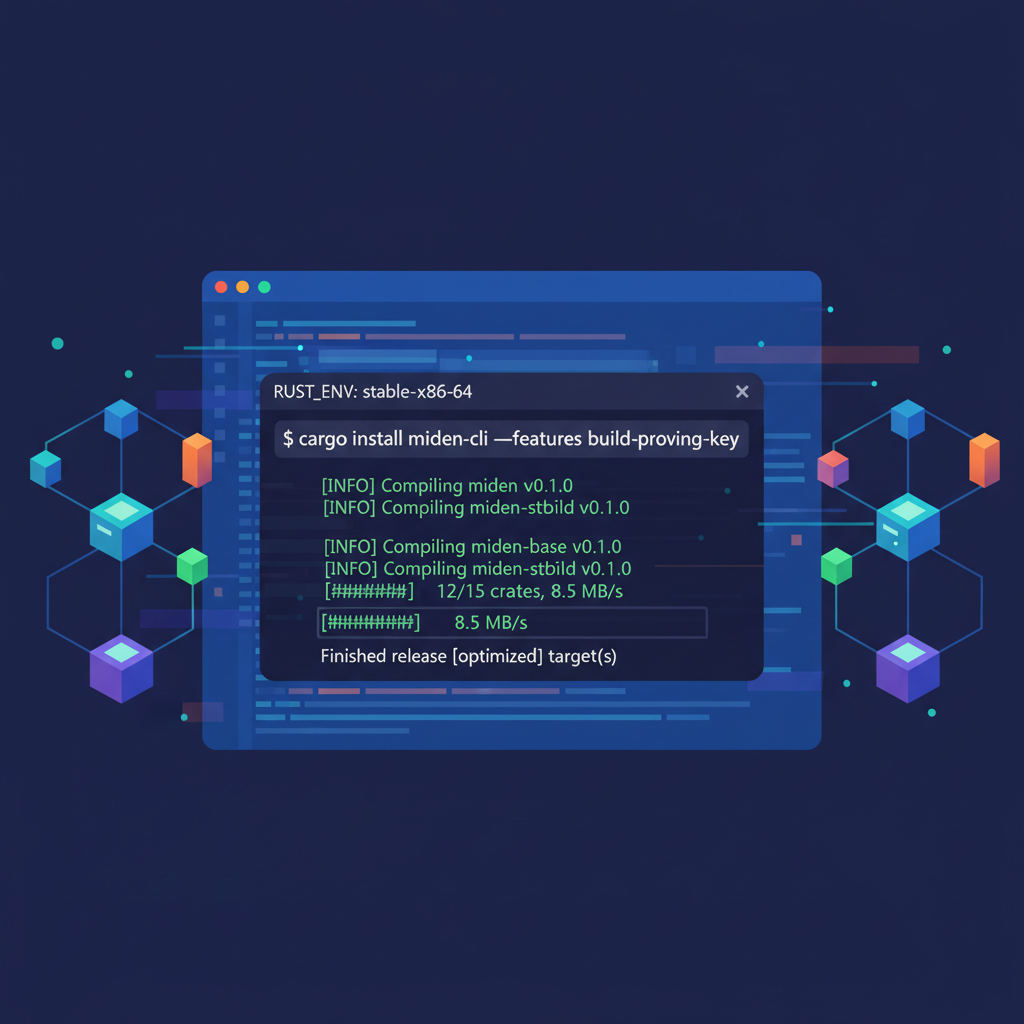
To demystify the process, consider constructing a basic private balance transfer. Developers initialize a Miden account, execute operations in the VM, and generate a STARK proof attesting to validity. The network verifies this proof swiftly, updating the global state without peeking inside. This pattern scales to sophisticated logic, reassuring builders that privacy holds under load.
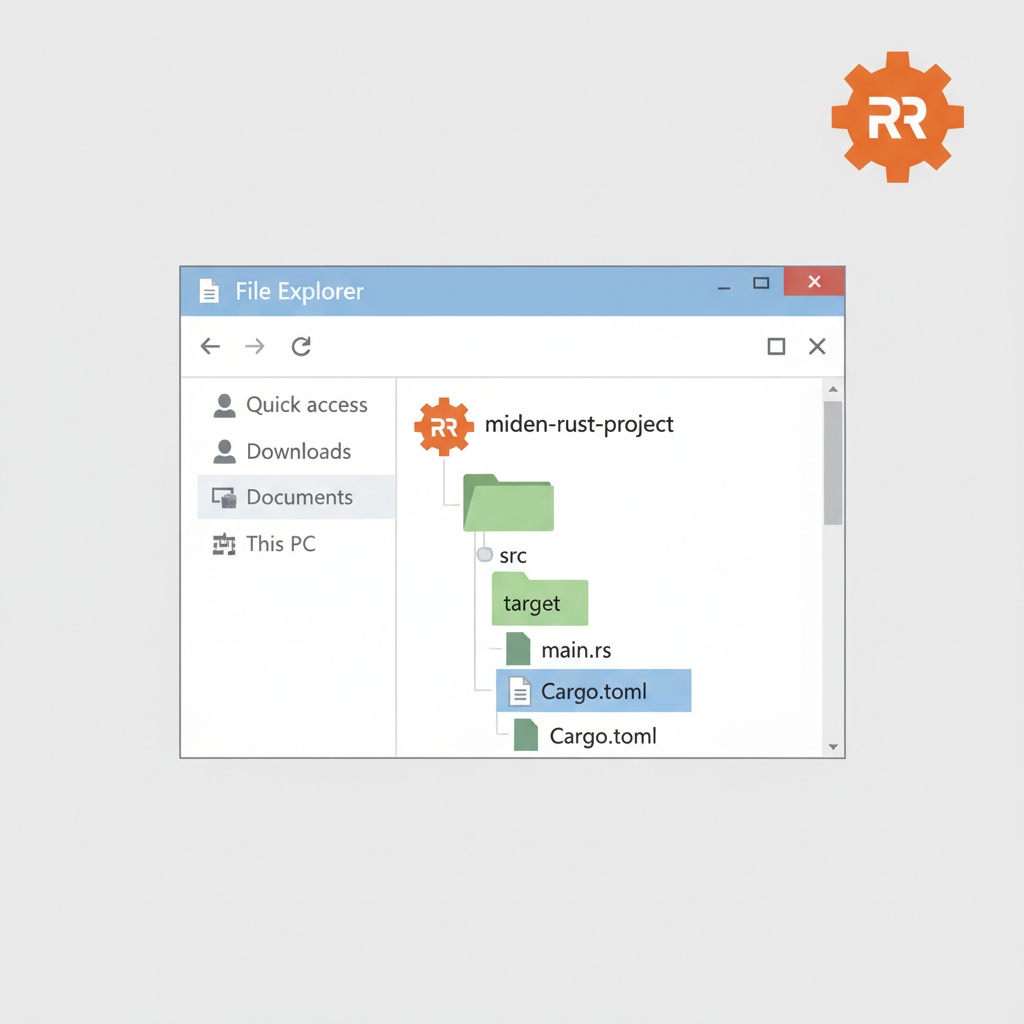
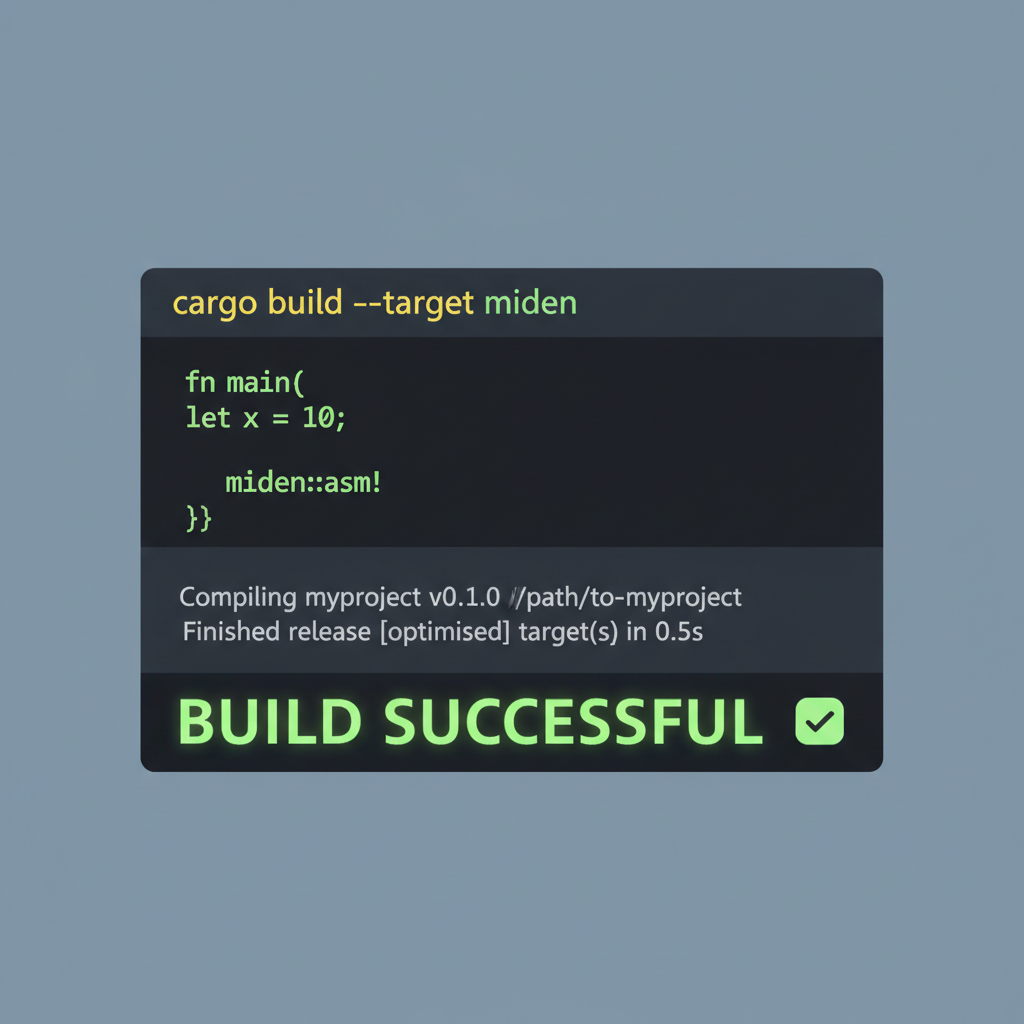
Build & Deploy Private Balance Transfer on Miden Testnet
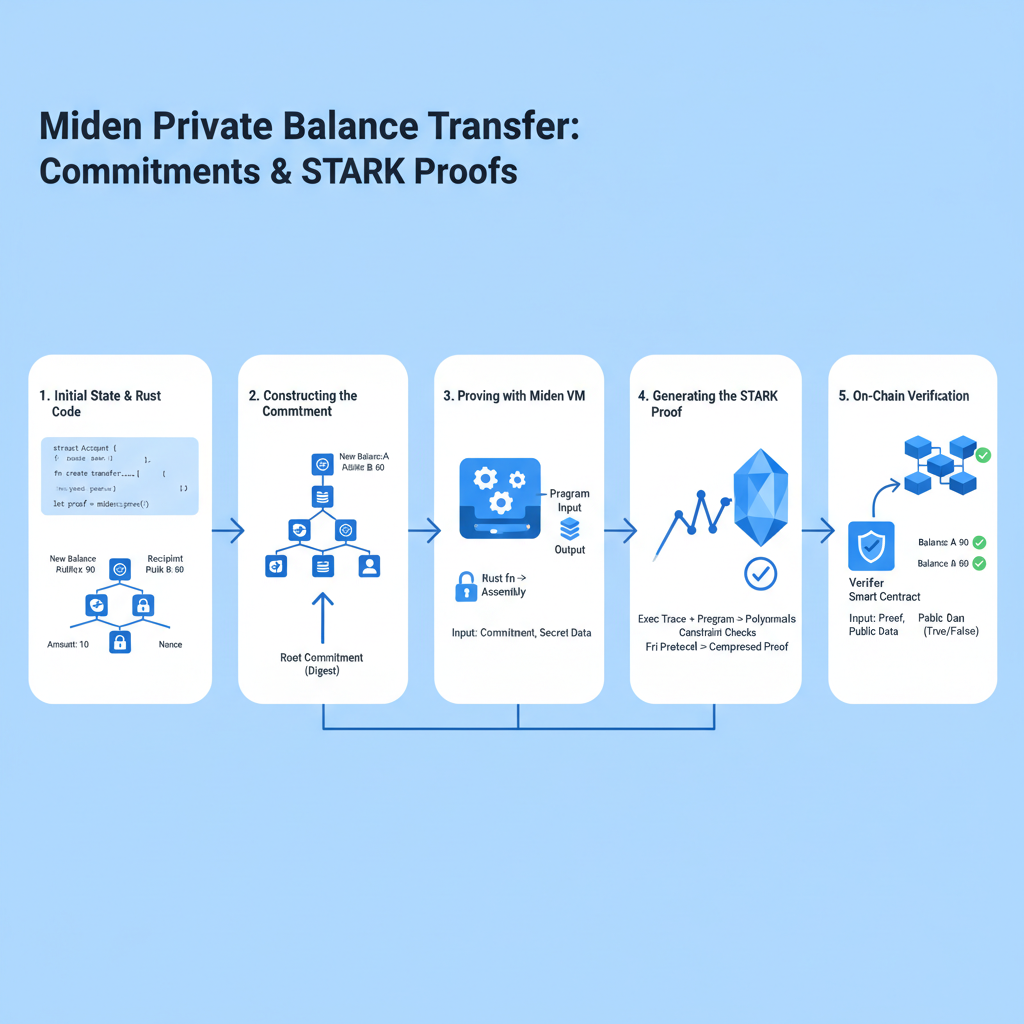
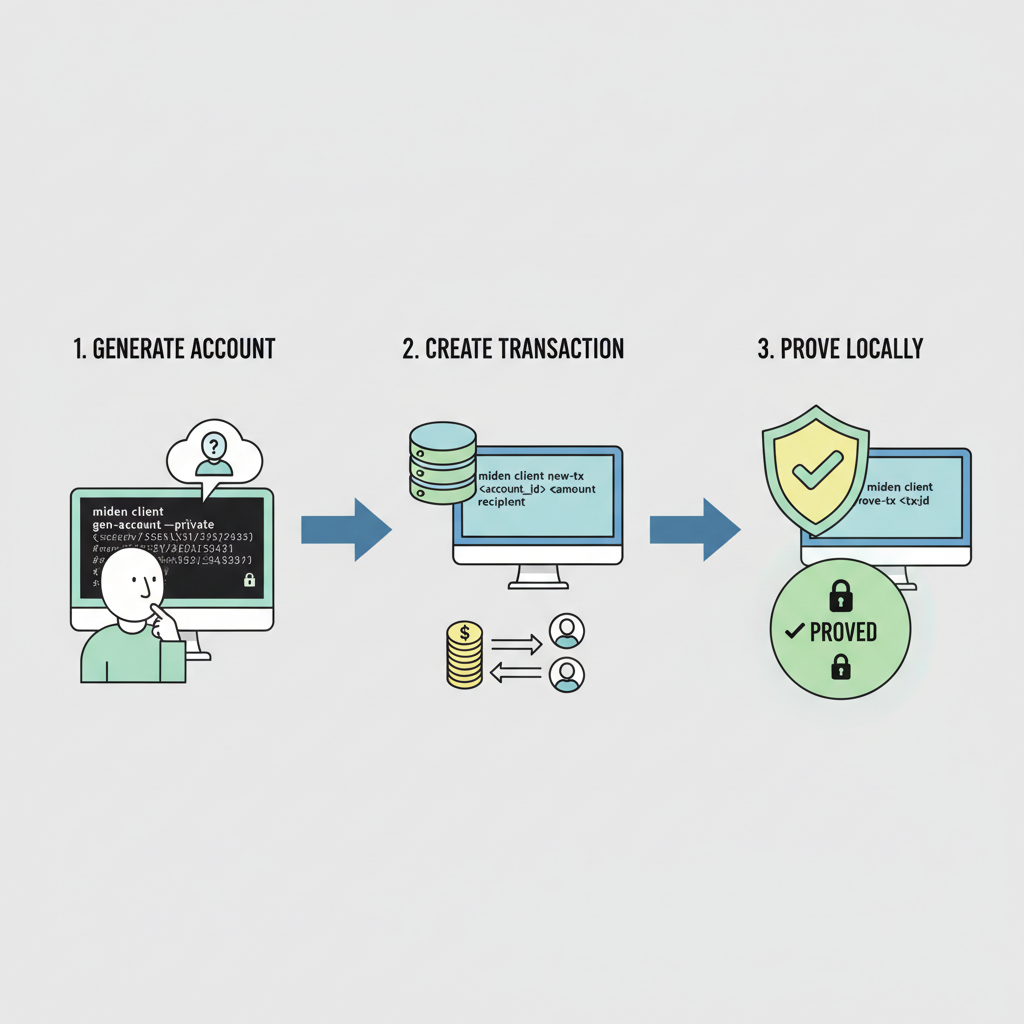
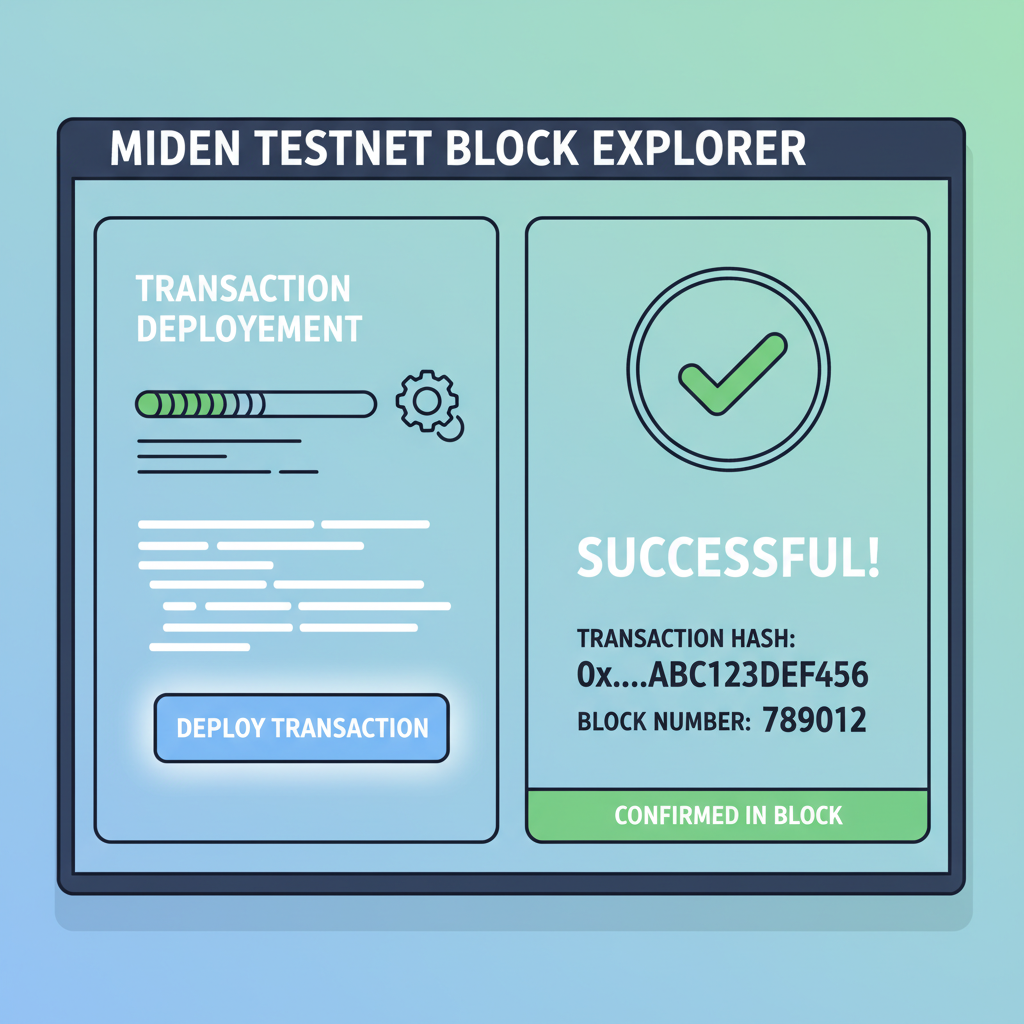
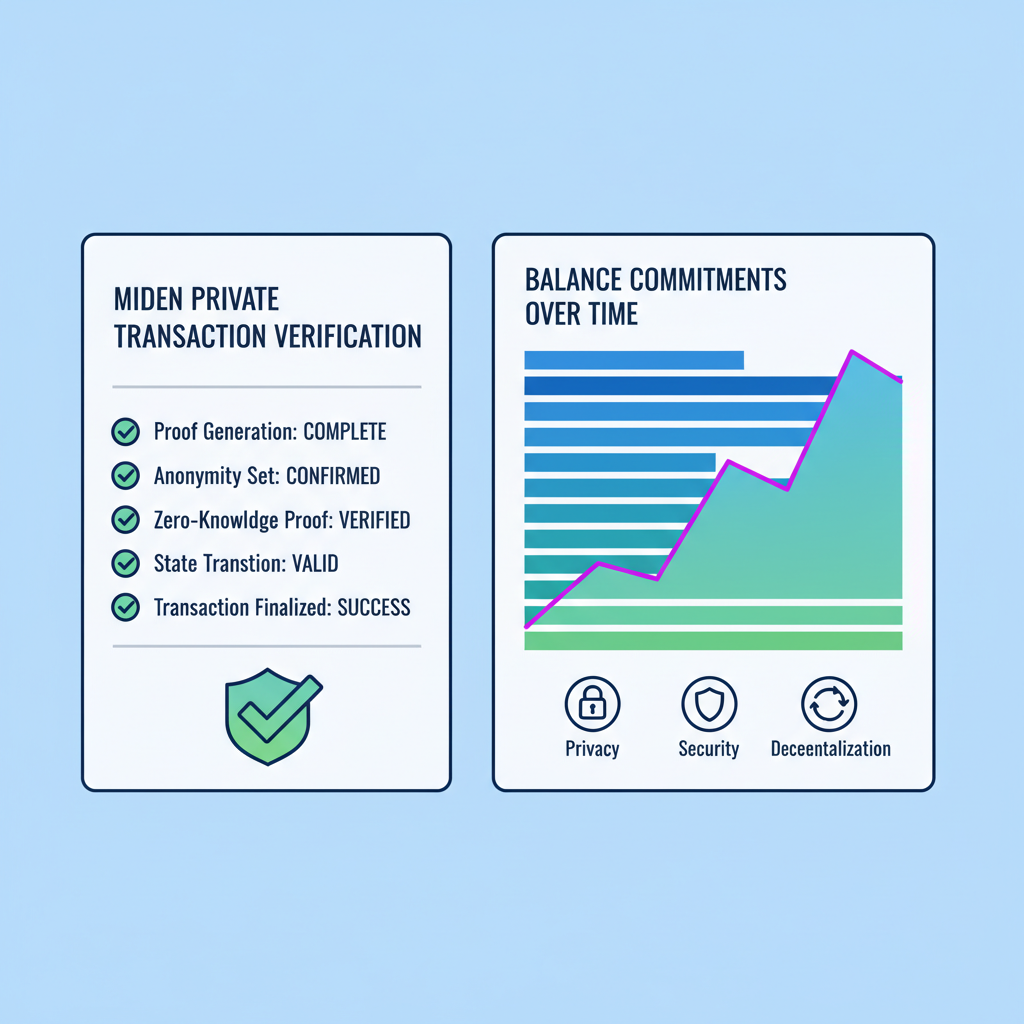
Once proven locally, the transaction joins a batch for aggregation. Miden’s prover network handles recursion, compressing proofs recursively for minimal on-chain footprint. This architecture reassures scalability skeptics: private DeFi can match optimistic rollups in TPS while upholding cryptographic guarantees.
Real-World DeFi Use Cases Primed for Miden
Picture Spark’s privacy-preserving order book: encrypted orders match off-chain, with STARKs confirming fair execution. Traders evade front-running, a plague on public DEXes. Yield aggregators could optimize strategies confidentially, proving APY without strategy leaks. Lending protocols shield borrower credit scores, fostering broader participation.
Miden’s dual-account model adds nuance. Public accounts handle compliance reporting, while private ones execute core logic. This hybrid reassures regulators demanding transparency alongside users craving confidentiality. As global privacy laws tighten in 2026, such designs position Miden ahead, enabling private DeFi smart contracts that thrive under scrutiny.
Miden’s client-side proving empowers users with control, much like running your own node but for privacy computations. It’s a reassuring shift from centralized trust.
Challenges persist, like proof generation times on low-end devices. Miden counters with hardware-optimized provers and future GPU integrations. Developer adoption hinges on tooling maturity; current Rust SDKs and simulators ease onboarding, bridging Ethereum devs seamlessly.
With mainnet in mid-Q2 2026, momentum builds. Funding bolsters ecosystem grants, drawing projects beyond DeFi into gaming and socialFi. Miden redefines blockchain privacy 2026 not as a feature, but foundational infrastructure. Builders deploying today on testnets position for explosive growth, crafting encrypted smart contracts that scale privately and securely.
Embracing Miden means betting on STARKs’ maturity. Their post-quantum security and transparency outpace alternatives, reassuring long-term thinkers. As private DeFi matures, Miden’s edge blockchain delivers the tools to build without compromise, one verified proof at a time.
About the Author